Best Flooring for Colorado Dry Climate: Homeowner Guide
Find the best flooring for Colorado dry climate homes. Prevent floor gaps and cupping with engineered wood, tile, and stone built for extreme low humidity.
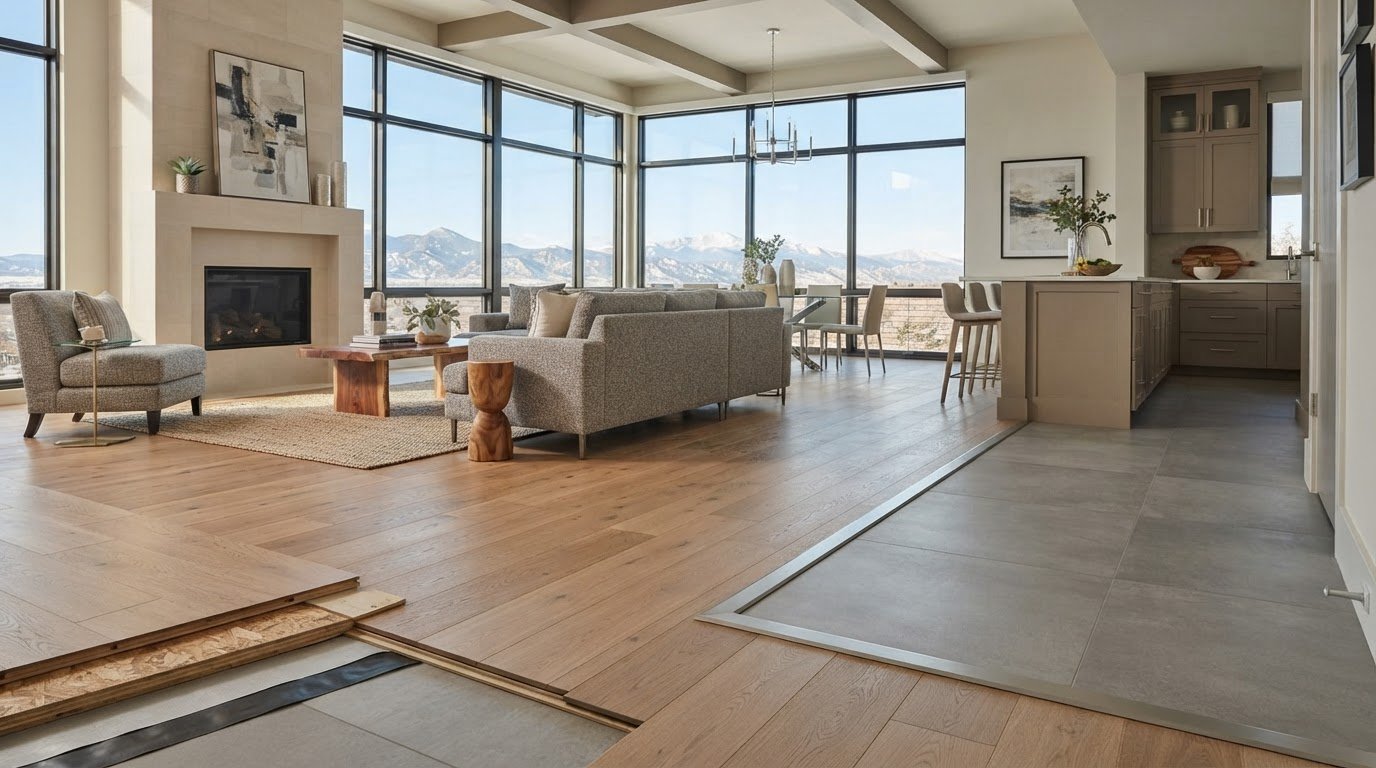
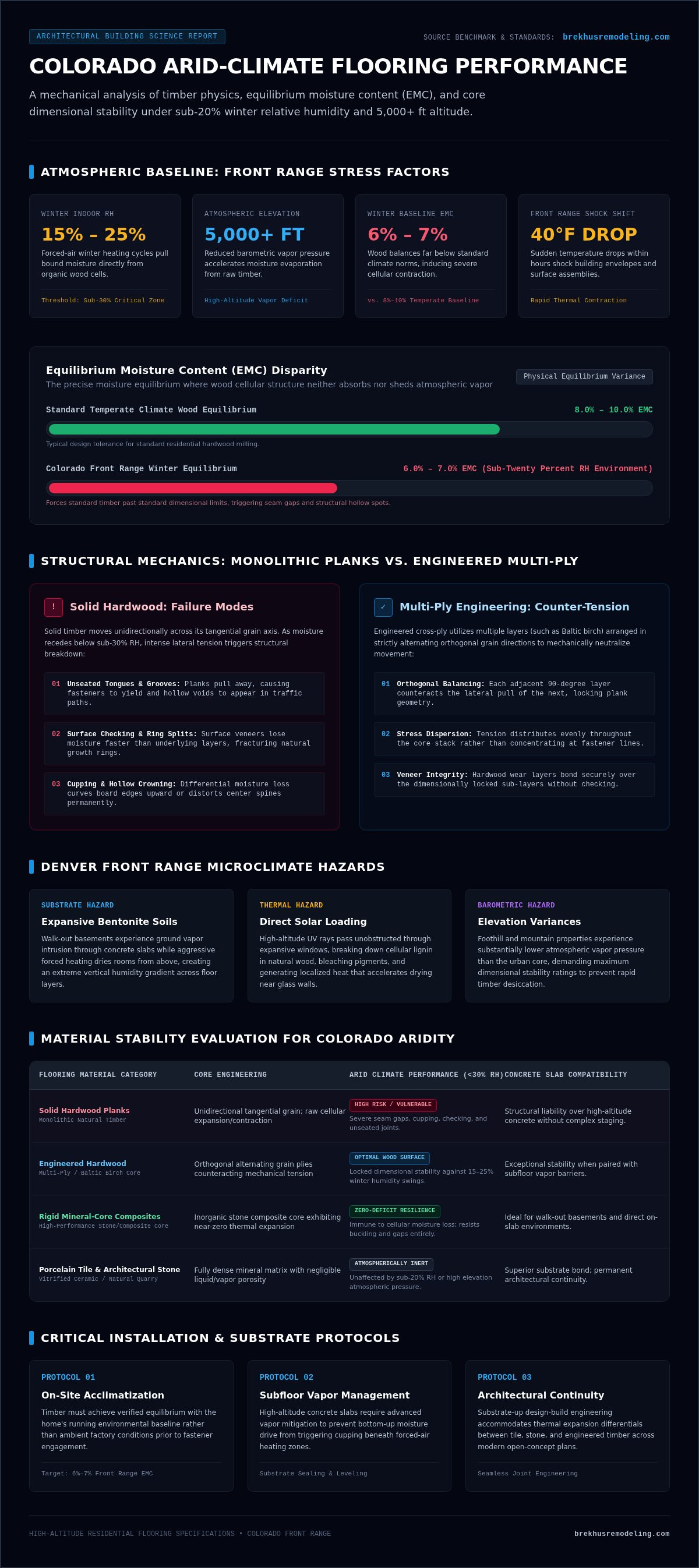
Traditional solid hardwood is celebrated as the pinnacle of residential design, yet in high-altitude environments, it often becomes a structural liability. When winter heating cycles drive indoor relative humidity down to 15 or 25 percent, raw timber shrinks rapidly, leaving behind unsightly board gaps, hollow spots, and fractured seams. Selecting the best flooring for Colorado dry climate conditions isn't just about surface aesthetics. It's an exacting engineering decision that demands materials engineered to withstand extreme elevation shifts and relentless atmospheric moisture loss.
You shouldn't have to accept seasonal floorboard separation or debate whether engineered wood or high-performance composites will hold their integrity over a concrete slab. This guide outlines the most durable, dimensionally stable flooring materials built to maintain structural resilience in sub-30 percent relative humidity. We examine the physics of each surface assembly, detailing critical subfloor preparation, vapor barriers, and architectural continuity to ensure your finished living space performs permanently.
Key Takeaways
- Understand how sub-twenty percent winter humidity and high elevation compromise solid timber, making cross-ply engineering essential for structural longevity.
- Identify why engineered hardwood, porcelain tile, and architectural stone rank as the best flooring for Colorado dry climate conditions over monolithic planks.
- Learn the critical role of subfloor vapor management and surface leveling over high-altitude concrete slabs to prevent board cupping and separation.
- Establish precise on-site acclimatization protocols to balance timber moisture content with your home running environmental baseline before installation.
- Discover how comprehensive design-build engineering from the substrate up delivers seamless architectural transitions across open-concept living spaces.
The Colorado Climate Challenge: How Aridity and Altitude Impact Residential Flooring
High-altitude environments fundamentally alter the behavior of interior finish materials. In Colorado, the semi-arid climate regularly pushes indoor relative humidity below twenty percent during the prolonged winter heating season. Compounding this, atmospheric pressure at 5,000-plus feet accelerates ambient evaporation, pulling bound water directly from organic wood cells. When wood loses moisture, it contracts along its cellular axes. Understanding how humidity impacts wood is critical to diagnosing early failure modes such as cupping, hollow crowning, and wide seam separation.
Every natural flooring material strives to reach equilibrium moisture content (EMC). In building physics, equilibrium moisture content is the precise balance point where wood neither absorbs nor sheds atmospheric vapor. Across most temperate climates, interior timber balances at eight to ten percent moisture content. Along the Front Range, however, baseline winter EMC plummets to roughly six to seven percent. Selecting the best flooring for Colorado dry climate conditions requires materials manufactured and detailed to survive this continuous moisture deficit without tearing themselves apart at the joints.
High-altitude solar radiation introduces another destructive dynamic. The thin atmosphere allows intense ultraviolet rays to penetrate expansive architectural windows, breaking down cellular lignin in natural wood while rapidly oxidizing factory coatings. Over time, localized surface temperatures rise dramatically, accelerating finish degradation and causing uneven pigment bleaching across open-concept floorplans.
The Mechanics of Seasonal Shrinkage and Surface Checking
Winter forced-air heating draws remaining humidity from living spaces, systematically shrinking microscopic timber pores. Wide-plank solid boards face severe lateral tension. As adjacent planks pull away from one another, fasteners yield, structural tongues unseat from matching grooves, and hollow voids appear beneath traffic paths. When dry surface veneers lose moisture significantly faster than the cooler sub-layers beneath them, internal stress fractures appear. These surface checks split natural growth rings, permanently marring top coats and weakening plank integrity.
Microclimate Variables Across the Denver Front Range
Regional geography creates unique structural friction inside local homes. Denver weather patterns frequently trigger sudden forty-degree temperature drops within hours, shocking interior building assemblies. These shifts create distinct performance variables across structural zones:
- Expansive Bentonite Soils: Walk-out basements face moisture intrusion through concrete slabs while high-volume interior heating dries the room from above, creating an extreme vertical humidity gradient.
- Direct Solar Loading: Floor areas adjacent to south-facing glass walls experience hyper-localized evaporation, drying boards far faster than interior corridor assemblies.
- Elevation Variances: Foothill properties experience lower atmospheric vapor pressure than the urban core, requiring the best flooring for Colorado dry climate demands to exhibit maximum dimensional stability.
Core Criteria for Selecting Flooring in Arid Environments
Selecting the best flooring for Colorado dry climate conditions demands evaluating structural mechanics rather than surface aesthetics alone. Visual appeal means nothing if dry air compromises plank geometry within two heating seasons. An objective evaluation framework rests on dimensional stability ratings, core engineering, subfloor cohesion, and factory coating chemistry.
Evaluating Dimensional Stability and Core Composition
Solid timber moves unidirectionally across its tangential grain axis, producing severe lateral separation as moisture recedes. In contrast, engineered flooring relies on multi-ply configurations, typically utilizing Baltic birch veneers arranged in alternating grain directions. Each orthogonal layer counteracts the mechanical tension of the adjacent ply, locking the assembly into dimensional stability. For below-grade installations over concrete slabs, rigid mineral-core composites provide near-zero thermal expansion, standing up to drastic humidity swings without buckling.
Wear Layer Integrity and UV Finish Specifications
Plank longevity depends on the caliber of its protective barrier. Premium engineered hardwood features multi-millimeter dry-sawn wear layers that permit future refinishing cycles while preserving balanced core mechanics. Modern factory finishes infused with aluminum oxide or ceramic bead formulations shield timber from abrasive foothill sediment carried into the home. Advanced UV-inhibiting sealers also prevent accelerated photochemical degradation, protecting deep natural stains from alpine sun bleached zones near floor-to-ceiling glass.
Warranty Thresholds and Environmental Compliance
Fine print matters in high-altitude environments. Most hardwood manufacturers void warranties if indoor relative humidity drops below thirty-five percent, a threshold Colorado winter heating consistently breaches. Installing whole-home steam humidification functions as structural insurance rather than simple personal comfort. Adhering to the specifications detailed in The Technical Standards of High-End Remodeling Finishes ensures finishes perform within verified environmental limits. When executing complex interior transformations, consulting with the design-build team at Brekhus Remodeling ensures every subfloor assembly and finish choice meets strict regional requirements.
Comprehensive Material Analysis: Comparing the Best Arid-Climate Flooring
Every finish material reacts differently when exposed to high-elevation aridity. While solid hardwood remains a traditional benchmark, its monolithic structure creates persistent maintenance liabilities in semi-arid zones. Identifying the best flooring for Colorado dry climate builds means comparing core physical compositions to find assemblies that resist movement without sacrificing luxury.
Engineered Hardwood: The Premier Balance of Luxury and Performance
Engineered hardwood represents the gold standard for high-altitude timber installations. Its cross-laminated multi-ply substrate neutralizes the intense lateral shrinkage that plagues solid planks during dry winter months. To achieve the best flooring for Colorado dry climate conditions, specify dry-sawn hardwood wear layers, which provide the authentic grain patterns, underfoot acoustics, and sandability of traditional lumber. Plank specifications make a tremendous difference in structural success:
- Cut Geometry: Rift-sawn and quarter-sawn face veneers offer superior dimensional stability over standard plain-sawn cuts, keeping boards flat across seasonal swings.
- Plank Dimensions: When design plans call for board widths exceeding five inches, an engineered multi-ply core is mandatory to prevent severe edge cupping.
- Species Selection: Dense domestic woods such as white oak paired with multi-ply Baltic birch backing deliver dependable resistance to dry-air fiber fatigue.
Porcelain Tile and Natural Stone: Complete Environmental Immunity
Dense ceramic porcelain and natural stone offer unmatched environmental resilience. Porcelain features near-zero water absorption ratings, rendering it completely unaffected by plunging humidity levels or localized furnace drafts. Natural stone varieties expand negligibly during rapid Front Range weather shifts while offering exceptional thermal mass. These dense surfaces integrate flawlessly across main-level living zones and wet areas, as detailed in The Definitive Guide to Premium Bathroom Renovation, providing uninterrupted visual continuity.
Rigid Core Luxury Vinyl (SPC): Maximum Resilience
Stone polymer composite (SPC) luxury vinyl delivers reliable performance in utility spaces, mudrooms, and lower levels. Constructed from finely pulverized limestone and polymer resins, SPC features a dense core that resists the dramatic thermal expansion seen in standard flexible vinyl. It resists telegraphing over minor slab variations and creates an impermeable barrier against the moisture differentials typical of finished walk-out basements.
Architectural Preparation: Acclimatization, Subfloors, and Radiant Heating
High-performance surface materials succeed or fail at the substrate level. Even the best flooring for Colorado dry climate applications will buckle, separate, or creak if installed over an unstable foundation. Front Range builders must engineer floor assemblies from the subfloor up, accounting for the dynamic equilibrium between subterranean slab moisture and arid indoor air.
Scientific Acclimatization Protocols for Front Range Homes
Acclimatization isn't a passive waiting period; it's a measurable scientific process. Storing boxed planks in an unconditioned garage or damp basement guarantees future board failure. Materials must rest inside the operational, HVAC-controlled space where they will permanently live. Installers should open carton ends and cross-stack boxes to distribute airflow evenly across every plank. Before fastening begins, technicians must measure timber moisture content using calibrated pin meters, verifying the wood matches the home's baseline target of six to nine percent equilibrium moisture content.
Subfloor Moisture Mitigation Over Concrete Slabs
High-altitude slabs present a dual threat. They continuously transmit ground vapor upward while low indoor humidity accelerates surface evaporation, creating severe vapor drive that damages flooring adhesives. Precision preparation requires definitive testing:
- Moisture Diagnostics: Conduct calcium chloride tests or place in-situ relative humidity probes to calculate moisture vapor emission rates before specifying adhesives.
- Vapor Barrier Application: Roll out fluid-applied epoxy vapor mitigation membranes to seal the concrete surface against upward hydrostatic movement.
- Subfloor Planar Tolerances: Grind down high points and apply cementitious self-leveling compounds to enforce a rigid flatness tolerance of three-sixteenths inch over a ten-foot radius. This eliminates structural bounce and joint fatigue in floating systems.
Integrating Flooring with Hydronic Radiant Heating Systems
Radiant subfloor heating pairs brilliantly with engineered timber, porcelain, and stone, provided the thermal system operates within strict physical boundaries. Always choose materials with lower thermal resistance ratings to ensure efficient thermal conductivity. System commissioning must follow a slow, incremental ramp-up, raising water temperatures only a few degrees each day to prevent thermal shock to wood cells and adhesives. Subfloor surface operating temperatures should never exceed eighty-one degrees Fahrenheit. To discover how radiant heating, structural substrates, and bespoke finish carpentry coordinate inside a unified project, review The Comprehensive Guide to Residential Full Remodels.
When you're ready to engineer your home's flooring system for permanent durability, contact the master craftsmen at Brekhus Remodeling to schedule a comprehensive structural assessment.
Executing Precision Flooring Installation with Brekhus Remodeling Standards
Selecting the best flooring for Colorado dry climate conditions represents only half of the structural equation. Even top-tier engineered planks or architectural stone fail if the underlying framework lacks stability. Brekhus Remodeling approaches every flooring installation through an integrated design-build lens. Rather than treating flooring as an isolated surface trade, our craftsmen engineer substrates, framing, and mechanical interfaces simultaneously to guarantee permanent performance across high-altitude living spaces.
Subfloor Flattening and Structural Deflection Control
Subfloor deflection under load creates hollow footfalls, broken plank tongues, and fractured tile grout. Before placing any surface finish, our team evaluates joist spans against rigid deflection thresholds, ensuring substrates remain completely motionless under active loads. On wood subfloors, we bond sheeting directly to framing with structural elastomeric adhesives and heavy-gauge ring-shank fasteners to stop seasonal friction squeaks. Over concrete foundations, our technicians mechanically grind down high ridges and float depressions with rapid-curing patch mortars to establish absolute planar uniformity.
Seamless Whole-Home Transitions and Architectural Cohesion
Open-concept living requires meticulous elevation planning. Standard trade crews often conceal substrate height variations behind clumsy T-moldings or abrupt threshold reducers. Brekhus Remodeling pre-engineers every finished floor height during the initial framing and underlayment phases. This foresight delivers flush, zero-threshold transitions where wide-plank wood meets custom kitchen islands or stone bathroom slabs. We plan continuous board alignments across expansive living spaces, maintaining clean architectural sightlines without awkward visual breaks.
Long-Term Environmental Management and Maintenance
Protecting custom flooring over decades requires proactive indoor atmospheric management. Integrating whole-home steam humidifiers directly into central HVAC ductwork stabilizes ambient humidity, shielding organic wood cells from severe winter moisture loss. For maintenance, specifying pH-neutral cleaning solutions protects factory-cured urethane and aluminum oxide topcoats from mineral haze and abrasion. By pairing the best flooring for Colorado dry climate environments with uncompromising installation standards, your interior finishes retain their beauty, structural integrity, and architectural value for decades.
Engineering Permanent Stability into Your Colorado Living Spaces
Achieving flawless, enduring floors in an arid high-altitude climate requires looking beyond surface aesthetics. Long-term performance hinges on selecting dimensionally stable multi-ply assemblies, respecting equilibrium moisture dynamics, and executing rigorous subfloor leveling and vapor mitigation. When you select the best flooring for Colorado dry climate demands, structural engineering must guide every phase of material specification and layout.
Backed by over two decades of precision residential remodeling experience across Denver, Brekhus Remodeling provides complete architectural oversight from the structural framing up. Our in-house specialists execute custom tile, stone, and architectural wood flooring installations designed to withstand extreme elevation shifts and seasonal humidity drops. Consult with Brekhus Remodeling to engineer your custom residential flooring installation and secure enduring beauty throughout your home.
Frequently Asked Questions
Can solid hardwood floors succeed long term in Colorado dry climate?
Solid hardwood can succeed, but it rarely functions as the best flooring for Colorado dry climate conditions unless backed by strict atmospheric controls. Planks wider than three inches face severe shrinkage and splitting when winter indoor humidity drops below 25 percent. Homeowners must run dedicated whole-home humidification year-round. For lasting reliability, multi-ply engineered boards deliver identical visual richness without structural separation.
What is the absolute best flooring material for homes along the Denver Front Range?
High-grade engineered hardwood featuring a multi-ply Baltic birch core ranks as the best flooring for Colorado dry climate installations across primary living areas. It pairs the authentic beauty and acoustic profile of natural timber with orthogonal layers that resist lateral movement. In bathrooms, entryways, and finished basements, porcelain tile and architectural stone provide complete immunity against high-altitude environmental shifts.
Why do wood floors cup, crown, or gap during Colorado winter months?
Wood floors deform because low ambient humidity forces organic timber cells to expel bound moisture rapidly. During Denver winter heating cycles, forced-air systems draw indoor relative humidity down to 15 percent. This deficit pulls moisture from plank surfaces faster than subfloors can adjust. As cellular fibers contract, lateral tension pulls boards apart, creating visible gaps, convex crowning, or cupping.
Is luxury vinyl plank suitable for high-altitude Colorado living spaces?
Yes, provided you specify rigid stone polymer composite (SPC) rather than traditional flexible luxury vinyl. SPC incorporates a dense limestone core that eliminates telegraphing and resists expansion caused by high-elevation temperature swings. It performs exceptionally well in Denver basements, mudrooms, and utility areas where concrete slabs transmit subterranean vapor while dry indoor air circulates overhead.
How long must flooring acclimate inside a Colorado home before installation?
Flooring acclimatization depends on measurable moisture equilibrium rather than an arbitrary calendar duration. Planks must rest inside the operational, climate-controlled living space until their moisture content matches the home's baseline environment, typically between six and nine percent across Denver. Professional installers cross-stack open cartons to distribute airflow and verify readings with calibrated pin meters before securing the first board.
How does in-floor radiant heating affect hardwood and tile selections in dry climates?
Radiant heating accelerates moisture evaporation, requiring materials with high dimensional stability and superior thermal conductivity. Porcelain tile and architectural stone excel over radiant heat because they transfer warmth efficiently without drying out or cracking. If installing engineered wood, select rift-sawn or quarter-sawn wear layers over multi-ply birch and strictly cap subfloor surface temperatures at eighty-one degrees Fahrenheit to protect wood fibers.
What indoor relative humidity level should Colorado homeowners maintain for hardwood floors?
Colorado homeowners should maintain an indoor relative humidity range between 30 and 45 percent to protect hardwood installations. Letting indoor moisture drop below 30 percent during freezing Front Range cold snaps risks checking, splintering, and voided manufacturer warranties. Integrating an automated whole-home steam humidifier into your central HVAC equipment provides the consistent environmental regulation necessary to preserve custom architectural flooring.