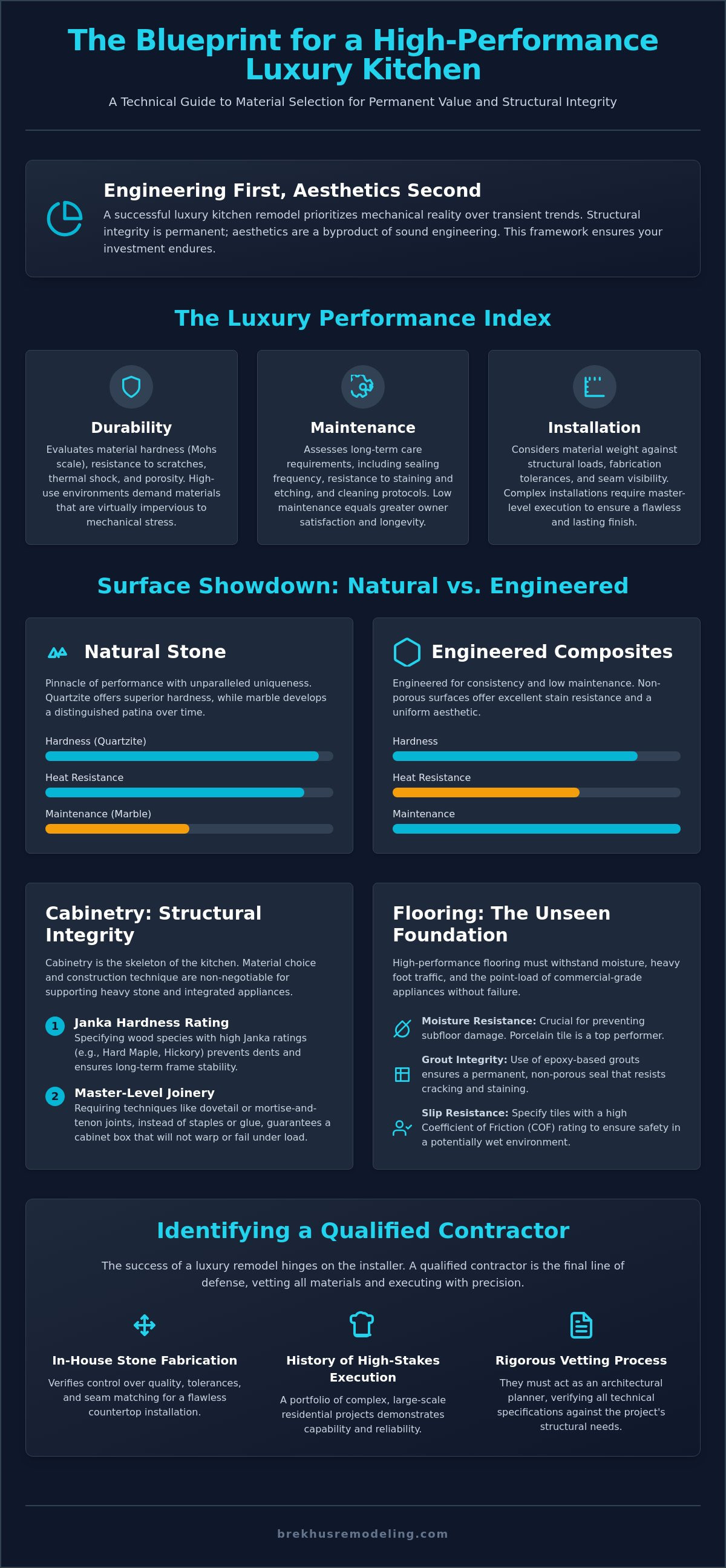
Choosing Materials for a Luxury Kitchen Remodel: A Technical Selection Guide (2026)
Stop guessing when choosing materials for a luxury kitchen remodel. Our 2026 technical guide focuses on durability, engineering, and long-term performance.
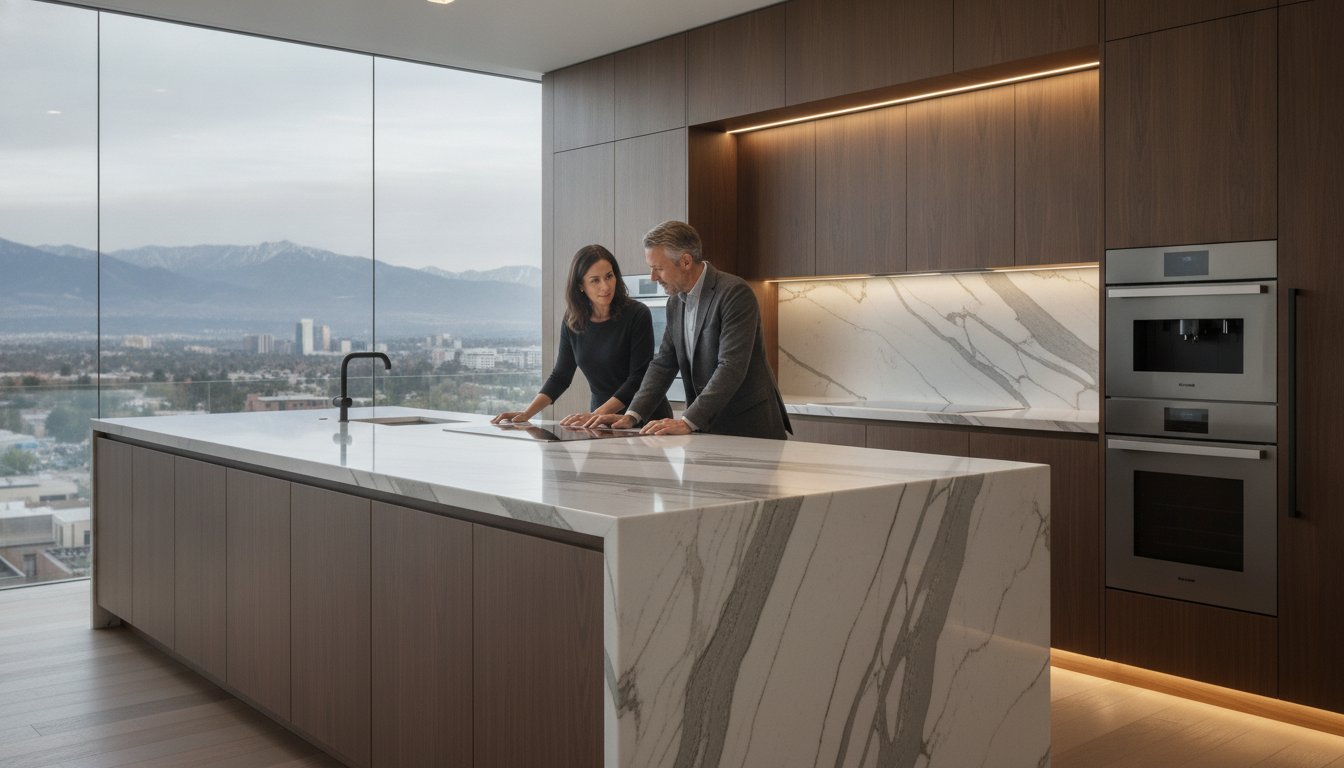
A luxury kitchen is a piece of high-performance machinery. Its longevity depends entirely on the technical specifications of its components. When choosing materials for a luxury kitchen remodel, the pressure to balance architectural beauty with structural integrity often leads to significant decision fatigue. It's common to feel overwhelmed by a marketplace that prioritizes transient aesthetics over the ruggedness required for a high-use environment. You recognize that a premium investment demands more than just a surface-level upgrade. It requires a disciplined selection of materials capable of withstanding the thermal and mechanical stresses of a professional-grade culinary space.
This guide serves as a masterclass in evaluating materials based on precision engineering and long-term reliability. We provide a clear framework for selecting surfaces and systems that offer permanent value. No marketing jargon. Just a focus on technical merit. You'll gain the confidence to identify materials that offer genuine durability, from quartzite slabs with specific mineral density to the latest 2026 appliance integrations. We also outline the standards of precision execution necessary to ensure your remodel remains a definitive example of craftsmanship for decades.
Key Takeaways
- Establish a rigorous standard for material selection by utilizing the Luxury Performance Index to measure structural integrity over aesthetic trends.
- Gain a technical edge when choosing materials for a luxury kitchen remodel by analyzing the geological density and installation requirements of premium quartzite and porcelain slabs.
- Guarantee cabinetry stability by specifying wood species with appropriate Janka hardness ratings and requiring master-level joinery for all custom millwork.
- Ensure the permanence of flooring systems through precision tile installation that addresses moisture resistance, slip-resistance, and long-term grout integrity.
- Identify a qualified kitchen contractor company by evaluating their internal stone fabrication expertise and history of high-stakes residential execution in the Denver area.
Establishing Technical Standards for High-End Kitchen Materials
Successful renovations begin with a shift in perspective. Aesthetics are a byproduct of sound engineering. When choosing materials for a luxury kitchen remodel, the primary objective must be the alignment of visual intent with mechanical reality. Trends are temporary. Structural integrity is permanent. A Denver estate requires materials that can withstand local atmospheric shifts while maintaining their architectural poise. This necessitates a rigorous vetting process that precedes any aesthetic decision. High-performance kitchens demand a disciplined approach to selection that prioritizes long-term ROI over surface-level appeal.
The Luxury Performance Index
We evaluate every surface through the Luxury Performance Index. This framework prioritizes three metrics: durability, maintenance requirements, and installation complexity. Assessing the porosity and hardness of surfaces intended for heavy culinary use is the first step. A material with a high absorption rate will fail under the demands of a professional kitchen, regardless of its initial beauty. We also examine thermal expansion coefficients. Materials must remain stable during the temperature fluctuations common in the Colorado climate. Clear documentation of maintenance for specialized finishes, such as unlacquered brass or honed marble, ensures the longevity of the investment is never compromised by neglect or improper care.
Coordinating Aesthetics with Engineering
Precision engineering dictates the limits of design. A massive quartzite island is a structural load, not just a countertop. We must align material weight with the existing floor joist capacity of the home. Reinforcement is often required before the first slab arrives at the site. Early coordination of a custom kitchen island design allows for the integration of necessary steel supports and internal bracing. This technical foresight extends to the hidden infrastructure. Plumbing and electrical layouts must be mapped to the exact specifications of professional-grade appliances. It is here that the standards of Kitchen Cabinetry Materials and Construction become vital. The cabinetry must support the weight of stone while housing complex mechanical systems with millimetric accuracy.
A qualified kitchen contractor company acts as the final line of defense during the procurement phase. Their responsibility is to vet the technical specifications of every material against the project's structural requirements. They verify that the chosen tile can handle the point-load of heavy appliances and that the stone fabrication meets the tolerances of a high-performance environment. This rigorous approach ensures that every component functions as part of a cohesive, rugged, and meticulously assembled system. Choosing materials for a luxury kitchen remodel is not a shopping exercise; it is an act of architectural planning.
Selecting Performance Surfaces: Natural Stone vs. Engineered Composites
Surface selection is the most critical intersection of culinary utility and architectural impact. When choosing materials for a luxury kitchen remodel, the decision between natural geological formations and engineered composites must be dictated by the specific mechanical demands of the space. Denver’s semi-arid climate presents unique challenges. Low humidity levels can accelerate the evaporation of solvent-based sealants, requiring a more rigorous maintenance schedule for porous materials. Professional stone installation isn't merely about placement. It's about managing these environmental variables to ensure the stone remains a permanent asset rather than a liability.
The Case for Natural Quartzite and Marble
Genuine quartzite represents the pinnacle of natural performance. It offers a Mohs hardness rating superior to granite, making it nearly impervious to scratches and thermal shock from high-temperature cookware. Marble, while softer and more prone to acid etching, remains a staple of estate-level design. For many, the gradual patina of marble is a deliberate aesthetic choice that signals authenticity. To protect these surfaces in high-use zones, we utilize high-grade impregnating sealers that penetrate the stone's molecular structure. This technical layer is vital in a dry climate where natural stone can become brittle if left untreated. Achieving a seamless look with these materials requires master-level book-matching and mitered edge profiles to create the illusion of a solid, monolithic block.
High-Performance Porcelain and Sintered Stone
Engineered surfaces like large-format porcelain and sintered stone offer a zero-porosity solution. These materials are manufactured under extreme pressure and heat, resulting in a surface that is fundamentally immune to staining and bacterial growth. The engineering challenge lies in fabrication. Ultra-thin porcelain slabs require specialized handling and precision cutting to prevent tension cracks during installation. While the cost-to-performance ratio is favorable for those seeking a maintenance-free environment, the installation demands are significantly higher than traditional stone. The rigidity of these slabs leaves no room for error in cabinet leveling or sub-surface preparation.
Executing these complex installations requires a partner with deep technical mastery. Whether you select the ruggedness of quartzite or the precision of sintered stone, the quality of the finish depends on the caliber of the assembly. You can explore our standards for expert stone fabrication to see how we manage these technical nuances. Every seam must be calculated. Every mitered corner must be sharp. The goal is a surface that performs as flawlessly as it appears, maintaining its structural integrity against the rigors of daily professional use.
Cabinetry and Millwork: The Intersection of Form and Structural Integrity
Cabinetry functions as the structural skeleton of the kitchen. While stone surfaces provide the workplane, the millwork manages the mechanical load of the entire system. When choosing materials for a luxury kitchen remodel, you must look beyond the species of wood to the engineering of the box itself. High-performance cabinetry requires a synthesis of material science and traditional joinery. This ensures that the storage systems remain dimensionally stable under the weight of premium stone and the constant cycle of culinary activity. A failure in cabinetry engineering is a failure of the entire renovation.
Wood Species and Climate Stability
Material selection must account for the semi-arid conditions of the Denver environment. Rift-sawn white oak offers superior dimensional stability compared to flat-sawn alternatives, as the vertical grain orientation resists the natural tendency to cup or warp. Walnut remains a prestigious choice for its rich figure, yet it requires meticulous kiln-drying to ensure it doesn't contract in low-humidity settings. We demand lumber that has been processed to a precise moisture content. High-end cabinetry must maintain a consistent moisture level between 6% and 8% during fabrication to prevent structural failure after installation. This technical rigor prevents the unsightly gaps and door misalignments that plague lesser installations.
The method of assembly defines the longevity of the millwork. We prioritize furniture-grade joinery, specifically dovetail drawer boxes and mortise-and-tenon door frames. These mechanical connections distribute stress across the wood fibers rather than relying solely on adhesives or metal fasteners. When evaluating storage capacity, the choice between frameless and inset cabinetry is a technical one. Frameless construction, often referred to as full-access cabinetry, maximizes interior volume and allows for wider drawer banks. Inset cabinetry offers a classic architectural profile but requires tighter tolerances; even a minor shift in the house's foundation can cause doors to bind if the box isn't perfectly square.
Hardware Engineering and Integrated Storage
Hardware is the primary point of mechanical failure in most kitchens. Luxury installations require soft-close hinges and drawer glides with weight ratings that exceed standard industry benchmarks. We specify systems capable of supporting 100 pounds or more, especially for deep drawers housing cast-iron cookware. This engineering precision extends to the integration of motorized lifts for heavy appliances and internal LED lighting arrays that activate upon opening. For high-touch surfaces, PVD-coated finishes on handles and pulls offer a ruggedness that traditional lacquers cannot match. These coatings are molecularly bonded to the substrate, ensuring the hardware retains its integrity through decades of use. Every component must be selected for its ability to perform under pressure, reinforcing the structural permanence of the custom kitchen.

High-Performance Flooring and Integrated Lighting Systems
The kitchen floor is the most physically abused surface in a residence. It must endure constant foot traffic, mechanical impact, and chemical exposure from culinary spills. When choosing materials for a luxury kitchen remodel, the flooring selection must be predicated on subfloor stability. Large-format stone or porcelain tiles require a deflection-free foundation to prevent fractures. We prioritize professional tile installation that begins with a structural assessment of the floor joists and the application of high-compression self-leveling underlayments. Without this technical preparation, the most expensive material will eventually fail under stress.
Architectural Flooring Selection
Material choice affects the acoustic and thermal profile of the home. Wide-plank engineered hardwood provides a warm aesthetic and superior sound dampening. Its multi-ply construction is specifically engineered to resist the contraction issues common in Denver's semi-arid climate. Natural stone tile offers unmatched durability and serves as the ideal conductor for radiant floor heating systems. These installations must adhere to TCNA-compliant standards to ensure that thermal expansion doesn't compromise the mortar bond. We evaluate materials based on their Coefficient of Friction (COF) to guarantee slip-resistance in high-moisture zones without sacrificing the stone's natural luster.
Technical Lighting Layouts
Lighting is a mechanical necessity that dictates the safety and utility of the workspace. A high-performance kitchen utilizes a three-layer system consisting of ambient, task, and accent illumination. We specify high-CRI (Color Rendering Index) LEDs with a rating of 90 or higher to ensure the accurate representation of food colors and finishes.
- Ambient Lighting: Recessed cans are placed with mathematical precision to provide uniform light without creating glare.
- Task Lighting: Under-cabinet arrays must deliver 500 to 800 lumens to the primary prep surfaces, eliminating shadows at the workstation.
- Accent Lighting: Dimmable tracks or integrated cabinet LEDs highlight the architectural depth of the millwork.
If you're ready to engineer a foundation that lasts, consult with our flooring specialists to review your project's technical requirements and ensure a flawless execution of your vision.
Selecting a Kitchen Contractor Company for Precision Installation
The process of choosing materials for a luxury kitchen remodel concludes with the selection of a firm capable of executing the vision. A high-performance material remains a liability if handled by a generalist. Precision installation is the final building block of a successful renovation. It requires a contractor who understands the geological properties of stone, the mechanical requirements of professional appliances, and the structural limits of the home. The caliber of the assembly must match the caliber of the materials to ensure the longevity of your investment.
Evaluating Craftsmanship and Technical Rigor
You must vet a kitchen contractor company by inspecting their portfolio of luxury kitchen remodel Denver estates. Focus on the micro-details. High-resolution site photos should reveal tight, consistent seam quality in quartzite slabs and perfect alignment in large-format tile layouts. Complex custom kitchen design and remodel work requires a dedicated project manager to synchronize mechanical, electrical, and structural trades with millimetric accuracy. A specialized residential builder differs from a generalist through their commitment to these technical nuances. They don't just manage a site; they engineer a kitchen.
The Brekhus Standard of Execution
Established in 2004, Brekhus Remodeling has spent over two decades refining the standards of residential excellence in the Denver market. Our firm specializes in the high-stakes execution required for premium materials. We maintain in-house capabilities for stone fabrication and tile mastery, ensuring that the structural integrity of your surfaces is never compromised by third-party errors. Our team manages every phase with disciplined precision, from the initial demolition to the final coat of architectural painting. We adhere strictly to 2026 building codes and architectural standards, providing a seamless coordination of plumbing and electrical systems.
A high-stakes kitchen transformation demands a partner who takes full responsibility for the outcome and values technical merit above all else. Our history of residential excellence is built on the promise of reliability and long-term value. We invite you to initiate your project with a firm that views remodeling as a disciplined engineering craft. Contact Brekhus Remodeling to begin the planning phase of your high-performance kitchen today.
Engineering Permanent Value in Your Kitchen Transformation
The success of a high-end renovation depends on a shift from aesthetic desire to technical requirement. Every component, from the mineral density of a quartzite slab to the moisture content of kiln-dried millwork, contributes to the project's structural permanence. Choosing materials for a luxury kitchen remodel is a process that demands a disciplined evaluation of the Luxury Performance Index. By prioritizing durability and precision engineering over fleeting trends, you ensure your estate remains a definitive example of craftsmanship for decades.
Brekhus Remodeling provides the technical mastery required for these high-stakes projects. With over 20 years of Denver craftsmanship and specialized stone and tile mastery, we offer a full-service approach to technical integration. Our team manages every mechanical and structural detail to protect the integrity of your investment. We invite you to move beyond the planning phase and begin the execution of a kitchen built to endure. Your vision deserves the rigor of a master craftsman who values substance as much as style.
Schedule Your Technical Consultation with Brekhus Remodeling and secure the architectural excellence your home deserves.
Frequently Asked Questions
What are the most durable materials for a high-traffic luxury kitchen?
Natural quartzite and high-performance porcelain represent the pinnacle of durability for high-use environments. These materials possess superior mineral density and zero-porosity ratings, making them nearly impervious to the chemical and mechanical stresses of a professional-grade kitchen. For cabinetry, selecting hardwoods with high Janka ratings, such as white oak, ensures the millwork resists impact and surface wear over decades of heavy use.
How do I choose between natural stone and engineered quartz for my countertops?
The decision depends on your requirement for thermal stability and geological authenticity. Natural quartzite survives direct heat exposure that can scorch the resin binders found in engineered quartz. When choosing materials for a luxury kitchen remodel, natural stone provides a superior mechanical advantage for active culinary spaces. Engineered quartz is suitable only when a specific, uniform pigmentation is the primary architectural requirement.
Why is professional stone installation critical for luxury kitchen remodels?
Professional installation ensures the structural load of massive stone slabs is distributed safely across the home's foundation. Master installers manage the technical nuances of book-matching and mitered edge profiles with millimetric accuracy. This level of precision prevents edge chipping and seam failure. It protects the material's integrity and ensures the finished surface meets the high standards of estate-level design.
What should I look for when hiring a kitchen contractor company in Denver?
Prioritize firms with a documented history of residential excellence and in-house stone fabrication capabilities. A qualified kitchen contractor company must demonstrate mastery in coordinating complex mechanical systems and adhering to the 2026 National Electrical Code. Verify their portfolio for high-stakes local projects to ensure they possess the technical rigor necessary for complex, estate-level renovations.
How does Denver's climate affect the choice of wood for custom kitchen cabinets?
Denver's semi-arid climate demands wood species with high dimensional stability, such as rift-sawn white oak. The low humidity can cause standard lumber to contract and warp, leading to door misalignment and structural gaps. We specify kiln-dried materials with a precise moisture content of 6% to 8% to guarantee the cabinetry remains stable through seasonal atmospheric shifts common in the Colorado front range.
Is high-performance porcelain a better investment than marble?
High-performance porcelain is a superior investment for homeowners prioritizing stain resistance and zero maintenance. Its manufacturing process creates a surface harder than granite that requires no sealing. Marble remains the standard for classical luxury, though its porous nature necessitates a commitment to regular sealing and an appreciation for the natural patina that develops over time. The choice rests on your preference for permanent perfection versus evolving character.
What technical specifications should I check before purchasing high-end appliances?
Verify the specific amperage, plumbing pressure, and ventilation requirements dictated by the manufacturer's technical guide. High-end professional ranges often require dedicated gas lines and high-CFM hoods that impact the kitchen's overall mechanical design. You must also account for current lead times. In 2026, semiconductor shortages and tariff impacts can extend procurement for smart appliances to 24 weeks or longer.
How do I balance aesthetic trends with long-term structural value?
Utilize the Luxury Performance Index to evaluate every selection. This framework dictates that structural integrity and maintenance requirements must outweigh surface-level trends. Invest in permanent architectural elements like stone and custom millwork that offer timeless durability. Reserve transient aesthetic trends for lighting fixtures or hardware that can be updated easily without compromising the kitchen's underlying engineering or permanent value.