Cost vs. Value Report: Strategic Home Remodeling in Denver (2026)
Explore the cost vs value report home remodel Denver 2026 to maximize ROI, navigate building codes, and prioritize high-impact renovation projects wisely.
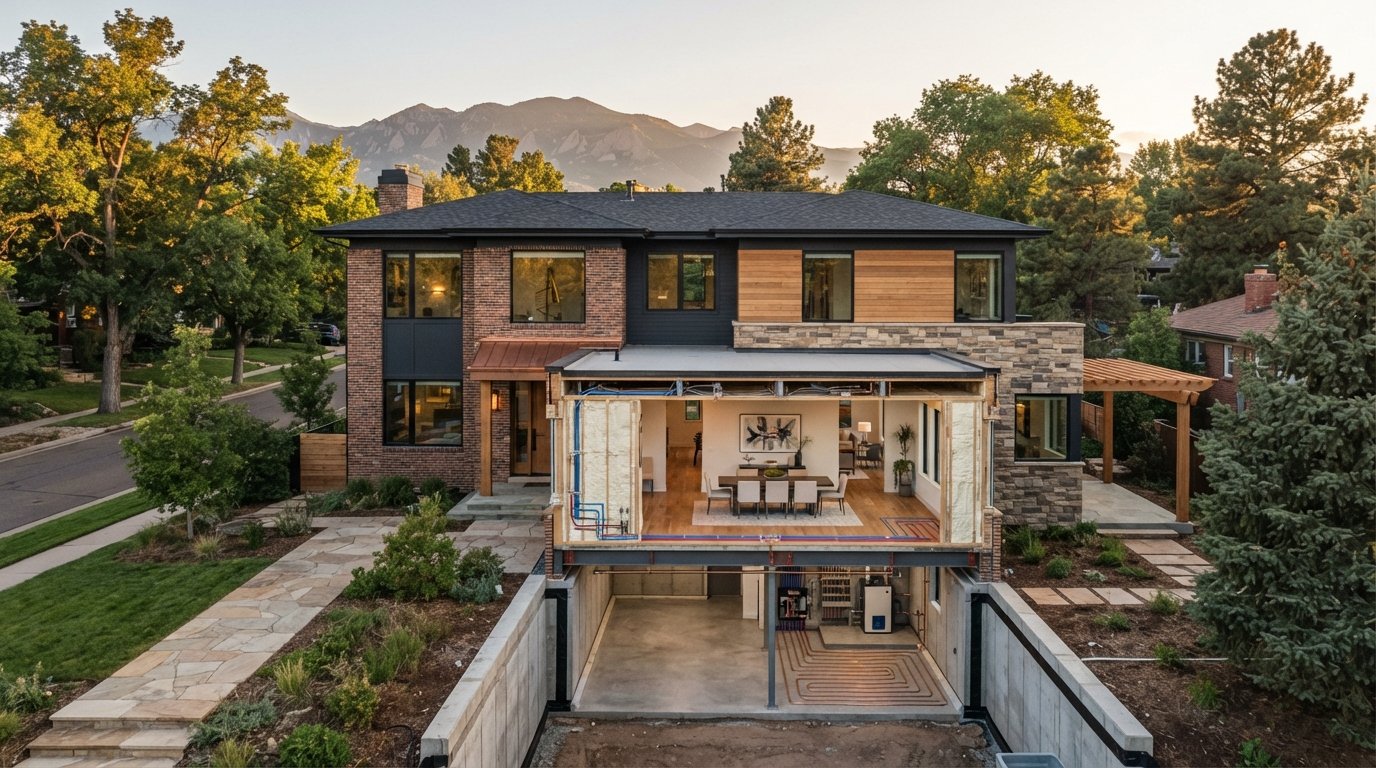
A premium renovation in 2026 is defined by technical rigor rather than just aesthetic appeal. In the current Denver market, the difference between a high-performance investment and a costly mistake lies in the engineering beneath the surface. You've likely felt the pressure of a stabilizing real estate market and the fear of over-improving for your specific neighborhood. This cost vs value report home remodel Denver 2026 offers the clarity required to navigate these complexities with unwavering confidence. We analyze the intersection of architectural integrity and financial recoupment, focusing on projects that deliver the highest return on investment and long-term durability. You'll gain a roadmap for project prioritization that balances luxury finishes with the technical demands of Colorado's unique climate and soil. This guide examines how the 2026 National Electrical Code and new energy mandates impact your renovation strategy. It provides a definitive look at how precision craftsmanship and structural longevity protect your home's appraised value. By focusing on substance over flashy trends, you ensure your property remains a steady asset in a competitive landscape.
Key Takeaways
- Identify the specific economic metrics and regional indicators that define the cost vs value report home remodel Denver 2026 results.
- Distinguish between high-impact exterior upgrades and lifestyle-focused interior renovations to prioritize projects with the highest recoupment potential.
- Evaluate the financial advantages of developing full basements as a high-value alternative to more complex and costly above-ground extensions.
- Learn how precision-engineered stone, tile, and technical installations prevent long-term structural failures and preserve your property's market position.
- Understand the critical role of professional plumbing and electrical support in meeting Denver's stringent 2026 building codes and energy mandates.
The 2026 Denver Remodeling Landscape: Defining Cost vs. Value
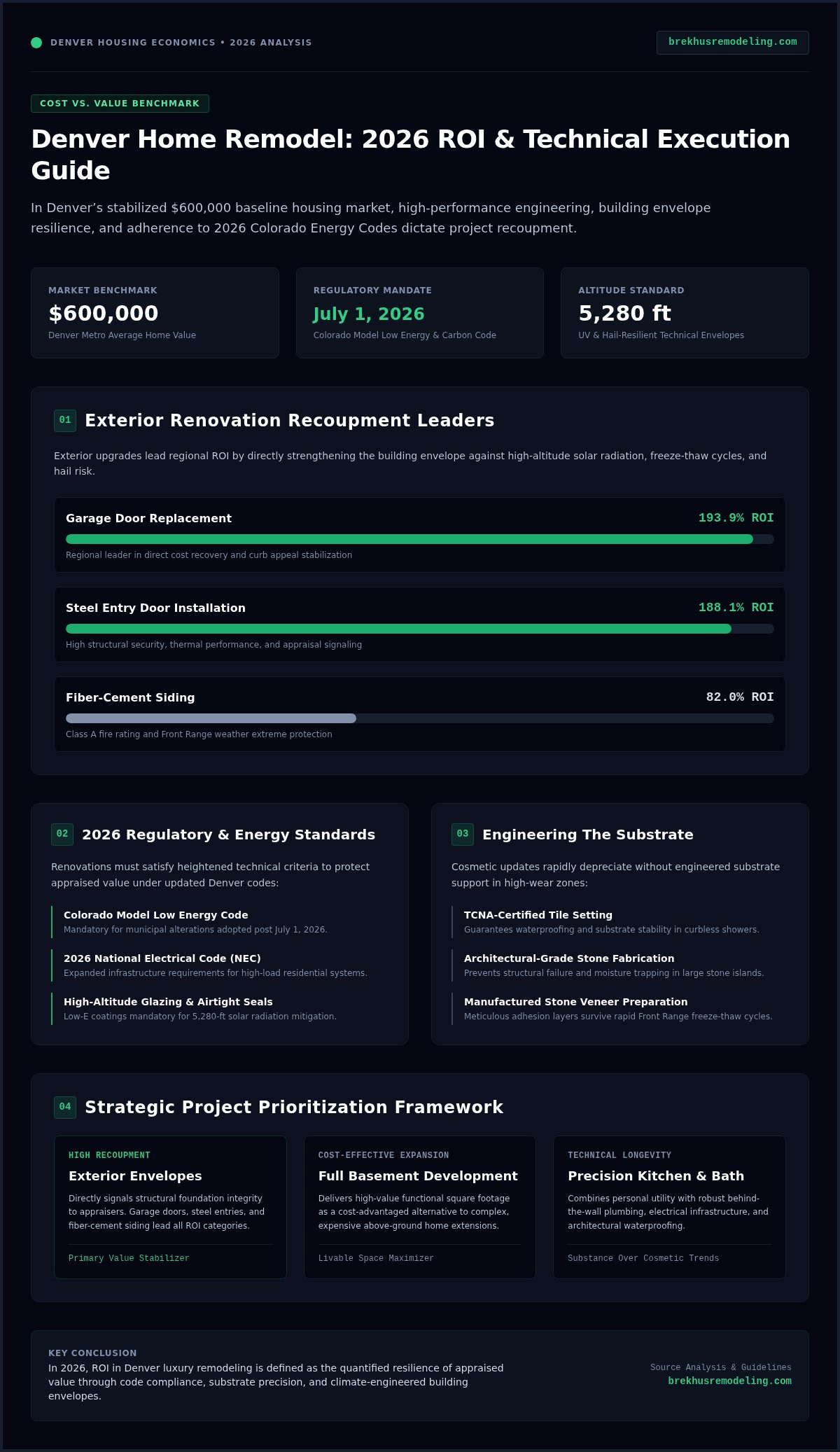
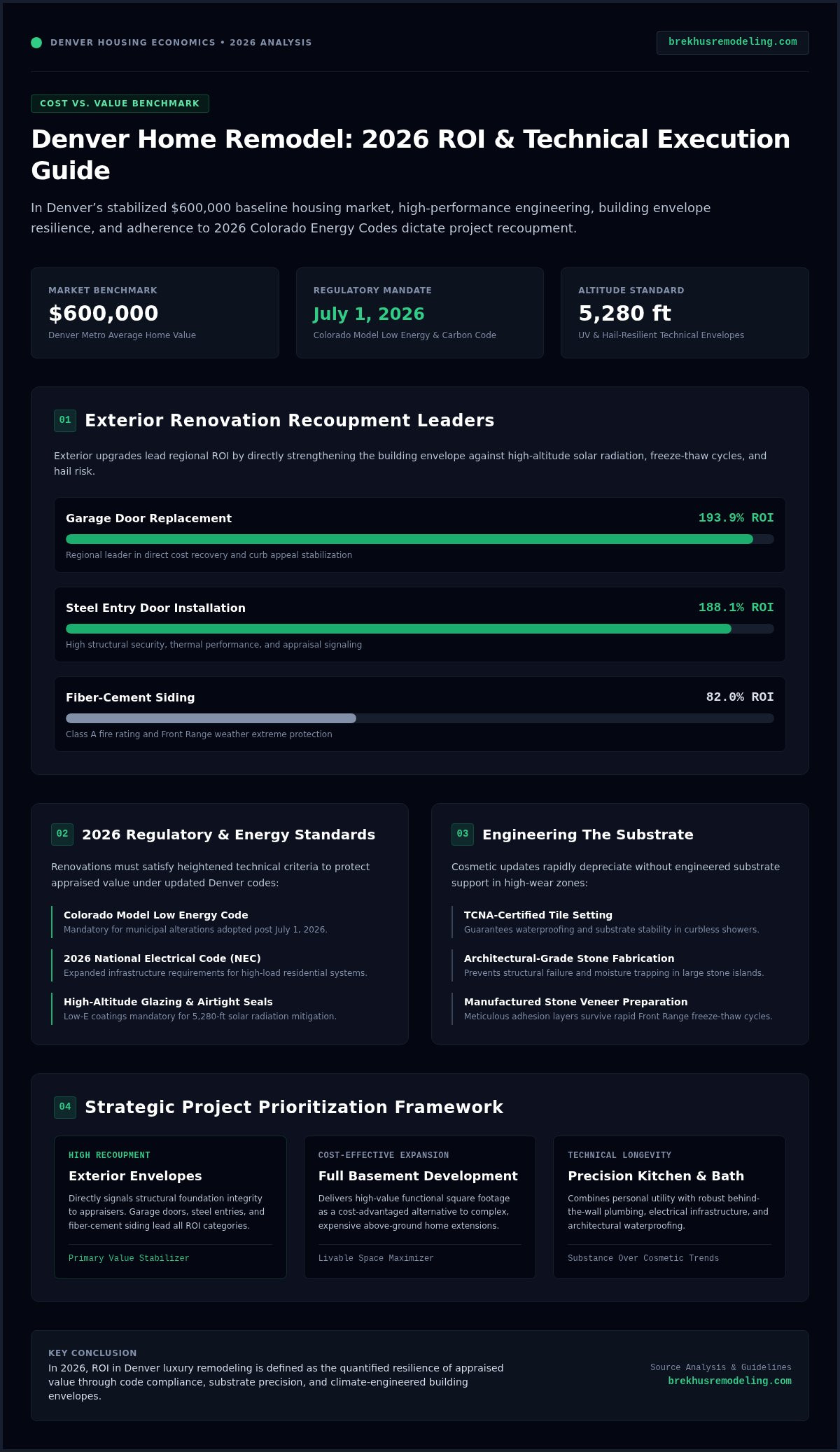
The Cost vs. Value metric represents the percentage of a project's cost that is recovered at the time of a residential sale. This calculation serves as a critical benchmark for homeowners planning a residential renovation and remodeling project. In the Denver metro area, where home values average approximately $600,000, understanding this ratio prevents the risk of over-improving for a specific zip code. Objective market value relies on appraisal data; lifestyle value reflects the personal utility of premium finishes. A successful cost vs value report home remodel Denver 2026 strategy integrates both by selecting upgrades that offer immediate functional benefits and long-term financial recoupment.
Mountain Region Market Dynamics in 2026
Denver's real estate environment in 2026 is characterized by stabilized home prices and selective buyer behavior. Tight inventory levels have made high-end renovations a primary vehicle for equity growth. Local preferences have shifted decisively toward high-performance homes that can withstand high-altitude UV radiation and severe hail risks. Energy efficiency is no longer a luxury; it's a regulatory requirement. Under the Colorado Model Low Energy and Carbon Code mandate, municipalities updating building codes after July 1, 2026, must enforce more stringent standards for major alterations. These regulations directly influence how appraisers and buyers assess the value of a modernized property.
The Technical Standard for Value Retention
Value retention depends on the technical execution of the build. Precision in the hidden systems of a home, such as plumbing and electrical infrastructure, prevents the rapid depreciation often seen in cosmetic-only fixes. When high-wear zones like curbless showers or expansive stone kitchen islands are installed, the quality of the substrate and waterproofing determines the project's lifespan. Professional standards, such as TCNA-certified tile setting and architectural-grade stone fabrication, ensure that the investment remains a permanent asset rather than a temporary aesthetic change. In Denver's 2026 luxury real estate market, ROI is the quantified resilience of a property's appraised value achieved through high-performance engineering and architectural precision.
Exterior ROI Leaders: Engineering Curb Appeal in Denver
Exterior renovations dominate the 2026 ROI charts, offering the most direct path to property value stabilization. Data from the cost vs value report home remodel Denver 2026 identifies garage door replacements as a regional leader, delivering a 193.9% return on investment. Steel entry doors follow closely with a 188.1% ROI. These figures represent more than simple aesthetic updates. They reflect a market demand for high-performance building envelopes that mitigate Colorado’s intense solar gain and severe hail risks. Appraisers prioritize these first impressions because they signal a well-maintained structural foundation. According to the Harvard Joint Center for Housing Studies, consistent reinvestment in exterior integrity is a primary driver of home price resilience during economic shifts.
Manufactured Stone Veneer and Architectural Finishes
Stone veneer serves as a high-yield architectural finish that provides the visual weight of masonry without the structural burden of full-bed stone. In the Denver metro area, technical execution is the difference between a permanent asset and a moisture-trapping liability. Proper adhesion requires meticulous substrate preparation to withstand frequent freeze-thaw cycles and 5,280-foot UV exposure. When installed with precision, manufactured stone veneer recaptures a significant portion of its cost by grounding the home's design and preventing the "flat" look of mass-market siding. Fiber-cement siding also remains a strong performer with an 82.0% ROI, valued for its Class A fire rating and durability against Front Range weather extremes.
High-Performance Windows and Doors
The integration of premium windows and doors is essential for meeting the 2026 Colorado Model Low Energy and Carbon Code. Thermal efficiency at high altitudes requires more than just high R-value glass. The installation seal must be airtight to prevent energy loss and moisture intrusion. Low-E coatings are mandatory to combat high-altitude solar radiation while protecting interior finishes from fading. These components function as the primary defense for your home's structural integrity. A precision-engineered exterior ensures that interior luxury remains protected. Securing the building envelope with high-performance windows and doors is a strategic first step toward maximizing your long-term equity in a competitive market.
Internal Remodels: Balancing Luxury with Livable ROI
Internal renovations present a paradox between immediate lifestyle utility and objective resale value. While exterior projects lead in pure percentage recoupment, the internal infrastructure of a home dictates the final appraisal ceiling. According to the cost vs value report home remodel Denver 2026, a minor kitchen refresh recaptures 96.1% of costs in the Denver metro area. In contrast, an upscale major kitchen remodel recaptures approximately 35%. This 61-percentage-point spread demonstrates that while luxury is desirable, the financial return is highest when upgrades focus on functional facelifts rather than total structural redesigns. Precision tile and stone work remain the primary differentiators in luxury perception, grounding the home's value in technical merit.
Kitchen Remodeling: A Masterclass in Functional Design
Modern floor plans reinforce the kitchen as the architectural hub of the home. This shift makes custom kitchen island design a central pillar of residential value. High-end kitchens in Denver's 2026 market demand stone and tile mastery to ensure 20-year durability. Integrating bespoke cabinetry with high-output luxury ranges requires engineered make-up air systems. These systems are necessary because gas mechanical systems must be derated by 4% per 1,000 feet above sea level at Denver's altitude. Selecting premium materials like architectural-grade stone slabs ensures the project withstands high-wear usage while maintaining its aesthetic integrity for future buyers.
Premium Bathroom Renovations and Custom Showers
A midrange bathroom remodel in Denver yields a 74.8% ROI, while luxury primary suite wet-rooms typically recoup between 50% and 60%. The technical foundation of these spaces is paramount for value retention. Upgrading plumbing and electrical for a home remodel is a non-negotiable requirement for meeting the 2026 National Electrical Code. All residential permits pulled after August 1, 2026, must comply with these updated standards enforced by Denver Community Planning and Development. Custom shower installation requires architectural precision and TCNA-standard waterproofing to prevent substrate failure on Colorado's expansive clay soils. These rigorous technical standards prevent costly tear-outs and protect the long-term equity of the master suite.
Expanding the Footprint: ROI of Basements and Extensions
Expanding a home's usable square footage remains the most significant lever for increasing appraisal values in the 2026 Denver market. The financial feasibility of this expansion depends on the choice between horizontal extensions or subterranean development. Current data from the cost vs value report home remodel Denver 2026 indicates that interior reconfigurations, specifically full basements, offer a superior ROI compared to ground-up extensions. While an exterior room addition averages between $250 and $450 per square foot, finishing a basement costs significantly less, ranging from $45 to $100 per square foot. This cost efficiency allows homeowners to capture a 70% to 75% ROI, which can peak at 86% in premium enclaves where strict lot coverage limits restrict outward growth.
The Sophistication of Full Basement Finishing
Developing a basement into a high-value living area requires addressing the technical challenges of Denver's sub-grade environment. The presence of expansive bentonite clay necessitates specific engineering solutions, such as floating interior partition walls with 1.5 to 3-inch voids at the slab level. These measures protect high-end finishes from foundation movement. Habitable spaces must also meet strict regulatory standards, including a minimum 7-foot clear ceiling height and continuous radon mitigation systems. Whether designing for multi-generational use or a bespoke entertainment suite, the integration of professional plumbing and electrical systems ensures the space meets the same rigorous standards as the upper floors. Architectural precision in waterproofing and vapor barriers prevents moisture intrusion, preserving the integrity of the investment.
Structural Home Extensions: Planning for Permanence
Structural extensions offer high lifestyle utility by adding essential bedrooms or expanding kitchen footprints. These projects face a complex regulatory environment in 2026. Denver Community Planning and Development now estimates a 180-day review period for major structural renovations and detached units. Achieving a unified look requires meticulous coordination of roofing materials and exterior finishes to ensure the addition appears original to the primary structure. Success in these high-stakes projects depends on end-to-end management of the building envelope and structural load. Homeowners seeking to expand their property's footprint should partner with a structural remodeling specialist to navigate zoning caps and ensure technical integrity.
The Brekhus Standard: Maximizing Value through Precision
Theoretical ROI provided by the cost vs value report home remodel Denver 2026 is only realized when the execution meets the highest technical standards. Professional craftsmanship serves as the ultimate insurance for your investment, protecting against the rapid depreciation common in lower-tier renovations. Handyman level work often overlooks critical engineering requirements, such as proper waterproofing in wet rooms or the necessary substrate support for heavy stone slabs. These shortcuts lead to substrate failure and moisture intrusion, which can necessitate total tear-outs within just a few years. By adhering to high-end remodeling finishes and rigorous structural protocols, homeowners ensure their property remains a high-performance asset.
Before entering a contract, homeowners should evaluate potential partners against a strict technical checklist to ensure value retention:
- TCNA Certification: Verification of Tile Council of North America standards for all stone and tile installations.
- Mechanical Integration: In-house management of plumbing and electrical systems to ensure compliance with the 2026 National Electrical Code.
- Soil Engineering: Proven experience in constructing floating partition walls to accommodate Denver's expansive bentonite clay.
- Architectural Slab Mastery: Precision templating and fabrication of stone slabs to eliminate structural stress points.
Precision Engineering as a Value Driver
The longevity of a remodel is dictated by the integrity of the work performed behind the walls. Meticulous stone, tile, and flooring installation prevents the shifting and cracking that often occurs on Colorado's volatile soils. When a renovation begins from the studs out, every component functions as part of a cohesive, high-performance system. End-to-end technical support for plumbing and electrical systems protects your ROI by ensuring the home meets modern energy mandates and safety regulations. This disciplined approach to construction eliminates the hidden costs of repair and replacement, grounding the home's appraised value in architectural merit.
Consulting the Experts for Your 2026 Project
Aligning your aesthetic vision with the cost vs value report home remodel Denver 2026 data requires a disciplined, no-nonsense professional partner. A master craftsman understands that luxury is not merely a surface treatment but a result of rigorous assembly and high-performance materials. Choosing a specialist who prioritizes substance over trendy marketing jargon ensures that your project withstands the scrutiny of future buyers and appraisers. The Brekhus Standard is the uncompromising fusion of architectural-grade precision and structural permanence in every residential renovation. By focusing on technical excellence today, you secure the financial and structural future of your home.
Securing Your Residential Investment for 2026 and Beyond
Success in the Denver market requires a strategic alignment of curb appeal and structural integrity. The cost vs value report home remodel Denver 2026 confirms that while high-impact exterior replacements offer immediate recoupment, the technical execution of interior spaces preserves long-term appraisal ceilings. Prioritizing subterranean development over outward footprint extensions provides a cost-effective path to expanded living space without compromising lot coverage limits. These decisions dictate your property's financial resilience in a stabilizing economy.
Strategic renovation is an exercise in engineering rather than mere decoration. Established in 2004, Brekhus Remodeling brings a legacy of structural rigor and specialized stone mastery to every project. Our full-service technical management ensures that your plumbing, electrical, and architectural finishes meet the highest standards of accuracy and longevity. You deserve a partner who values technical merit as much as aesthetic excellence. Consult with Brekhus Remodeling for your precision-engineered Denver renovation. Your home's future value begins with the precision of today's build.
Frequently Asked Questions
What is the highest ROI home remodel project in Denver for 2026?
Garage door replacements currently yield the highest return on investment in the Denver metro area, delivering a 193.9% recoupment. Steel entry door replacements follow closely with an 188.1% ROI. These exterior upgrades provide immediate curb appeal and structural fortification against high-altitude weather. Data from the cost vs value report home remodel Denver 2026 indicates that prioritizing the building envelope is the most efficient method for stabilizing property value before a residential sale.
Does a major kitchen remodel pay for itself at resale?
An upscale major kitchen remodel typically recaptures approximately 35% of its total cost at resale. While these projects offer significant lifestyle utility and architectural distinction, they're considered discretionary investments rather than high-ROI projects. Homeowners seeking better financial recoupment should focus on minor kitchen refreshes, which recapture 96.1% of costs. These functional updates prioritize precision stone and tile work over total structural reconfiguration to maximize the appraised value of the home's hub.
How much value does a finished basement add to a Denver home?
Finishing a basement in Denver adds substantial value by increasing habitable square footage at a lower cost than above-ground additions. These projects typically yield a 70% to 75% ROI, though this can reach 86% in premium neighborhoods with restricted lot coverage. Developing the subterranean level is a strategic alternative to extensions, providing high-performance living space for multi-generational use or entertainment while complying with Denver’s strict 7-foot ceiling height and egress requirements.
Is it worth upgrading plumbing and electrical during a cosmetic remodel?
Upgrading technical systems is essential for protecting the long-term integrity of a cosmetic remodel. Modernizing plumbing and electrical infrastructure ensures compliance with the 2026 National Electrical Code, which is mandatory for all residential permits pulled after August 1, 2026. These upgrades prevent substrate failures and moisture intrusion in high-wear zones like custom showers. Investing in the home's bones provides the necessary insurance for high-end finishes, ensuring the renovation remains a permanent asset rather than a temporary fix.
What is the difference between cost and value in home renovation?
Cost refers to the total expenditure required for materials, labor, and technical management of a build. Value represents the objective increase in the property's resale price as determined by market appraisals. The relationship between these two figures defines the return on investment. In the cost vs value report home remodel Denver 2026, this metric helps homeowners distinguish between subjective lifestyle improvements and objective financial gains, allowing for a disciplined approach to project prioritization and material selection.
How do Denver's 2026 permitting laws affect remodeling ROI?
Denver’s 2026 permitting environment has established review targets of approximately 180 days for complex structural additions and detached units. This extended timeline increases the carrying costs of major extensions, often reducing their immediate financial ROI. Consequently, internal reconfigurations and basement finishing have become more attractive options for value growth. Navigating these regulatory standards requires a partner capable of end-to-end technical management to ensure the project remains on schedule and within code compliance.
Should I focus on exterior or interior projects if I plan to sell in two years?
Homeowners planning to sell within two years should prioritize exterior replacements to maximize immediate recoupment. Statistical evidence shows that 8 of the top 10 ROI-producing projects in the Mountain Region are exterior updates, including garage doors, siding, and manufactured stone veneer. These projects offer the highest percentage of cost recovery and prevent price discounting during the listing period. Interior overhauls should be limited to minor functional refreshes that emphasize cleanliness and technical reliability rather than bespoke structural changes.
Why is stone veneer considered a top-tier investment for Denver homes?
Manufactured stone veneer is a top-tier investment because it provides architectural weight and aesthetic grounding with a high 2026 ROI. This material offers the visual impact of masonry without the structural load or foundation requirements of full-bed stone. In Denver’s variable climate, properly installed veneer protects the building envelope from intense UV exposure and freeze-thaw cycles. It delivers a sophisticated first impression that signals quality and attention to detail, which are critical metrics for high-end residential appraisals.