High-End Stone Installation Denver: The Architectural Standard for Luxury Residences
Discover the architectural standard for high-end stone installation Denver. Learn the engineering secrets to a flawless, museum-quality finish that lasts a l...
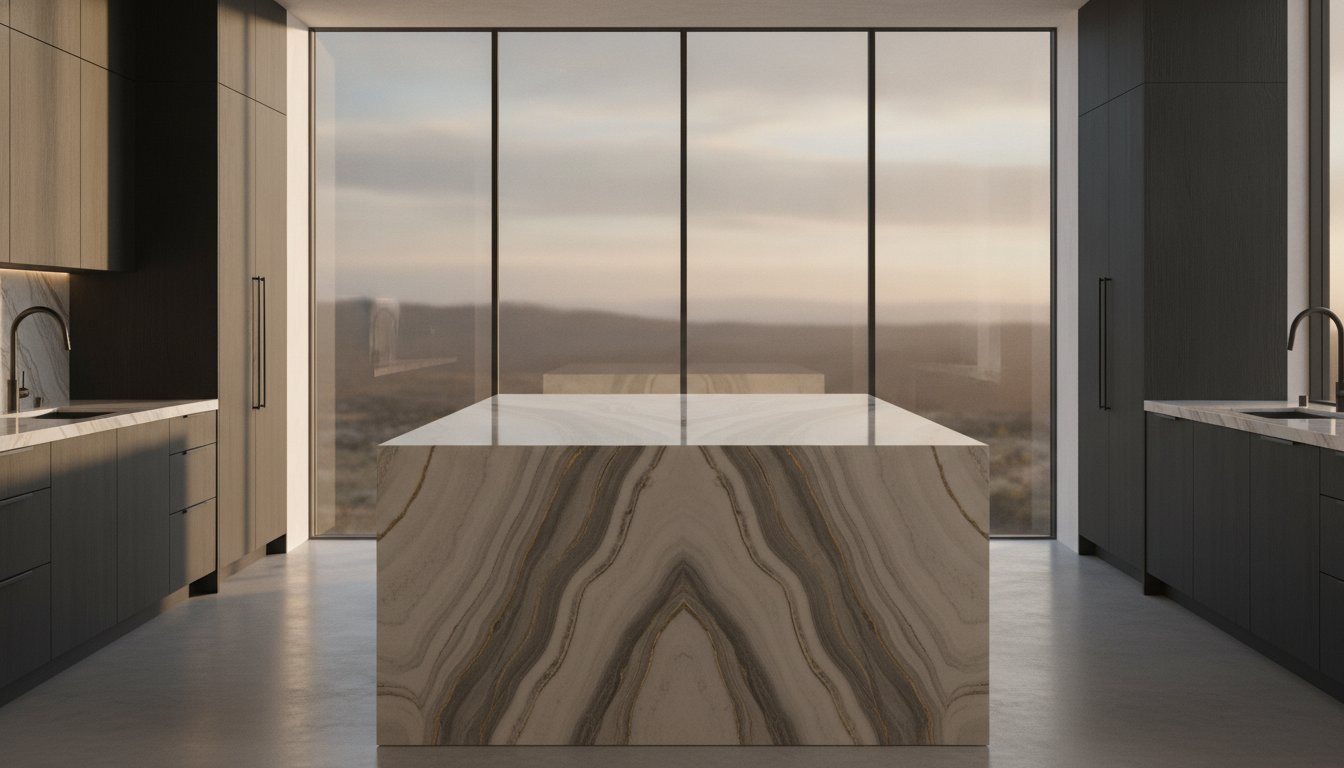
True architectural luxury is not found in the slab itself, but in the invisible engineering that ensures it never moves, cracks, or fails. For homeowners seeking high-end stone installation Denver, the distinction between a standard contractor and a master craftsman lies in this technical rigor. It's a standard where structural integrity dictates the aesthetic outcome, rather than the other way around. You recognize that a single poorly matched seam or a fracture caused by improper substrate preparation can compromise the value of an entire residence.
This article provides the technical and aesthetic framework required to master premium stone installation. You'll gain clarity on the performance nuances between materials like marble and quartzite, specifically regarding Denver's unique environmental demands. By understanding the standard of engineering from the studs out, you can ensure your project achieves a flawless, museum-quality finish that significantly increases property valuation. We will detail the exact requirements for substrate stability, digital templating, and the precision fabrication necessary for timeless elegance.
Key Takeaways
- Understand the critical distinction between standard fabrication and architectural high-end stone installation Denver, where structural engineering dictates the final aesthetic.
- Identify the technical performance differences between marble and quartzite to select materials that offer both visual movement and long-term durability.
- Learn how to verify floor joist capacity and substrate preparation to prevent stone cracking and ensure the permanence of heavy, large-format slabs.
- Master the role of digital templating and CNC fabrication in achieving seamless transitions and precise edge profiles in complex architectural spaces.
- Discover the advantages of managing stone integration through a general contractor to ensure perfect alignment with custom cabinetry and high-end plumbing fixtures.
The Architectural Standard of High-End Stone Installation in Denver
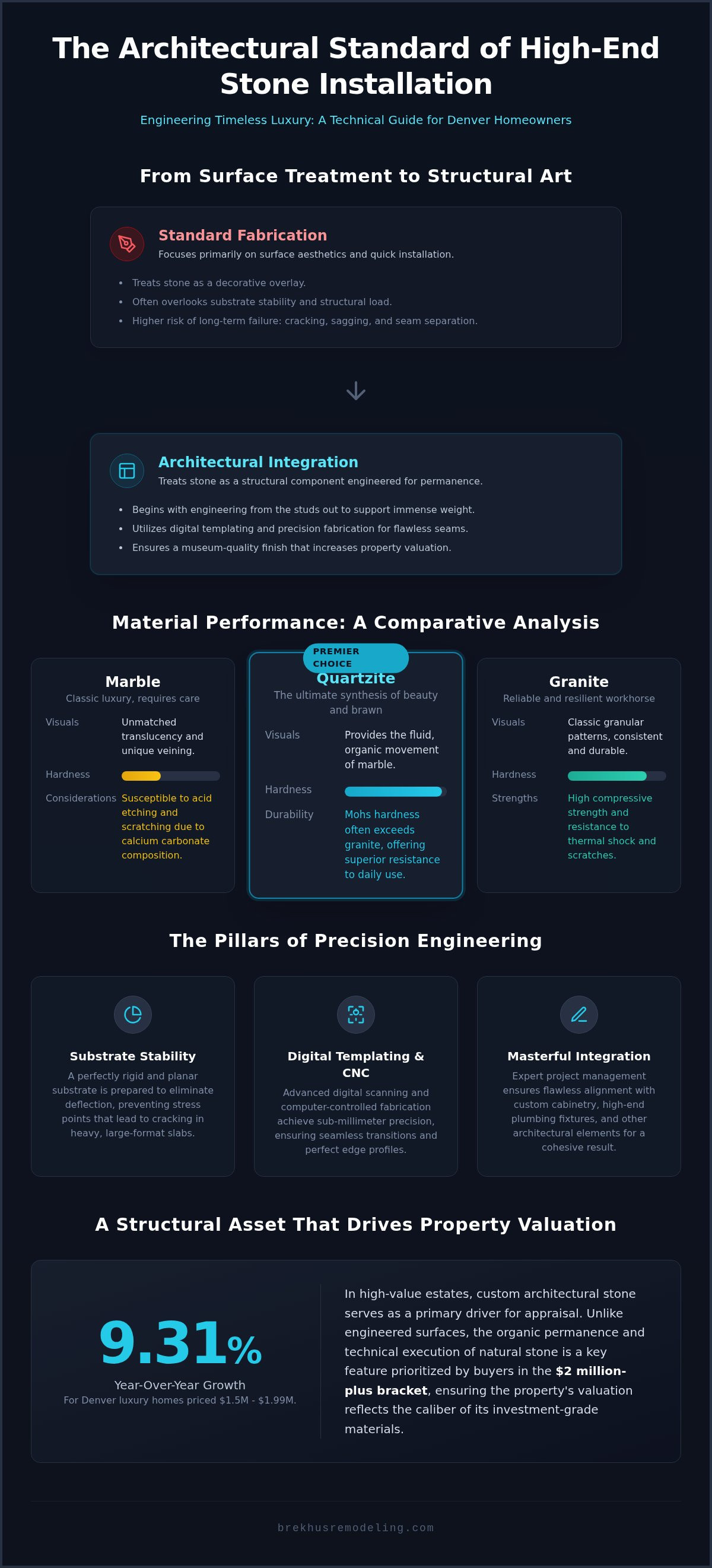
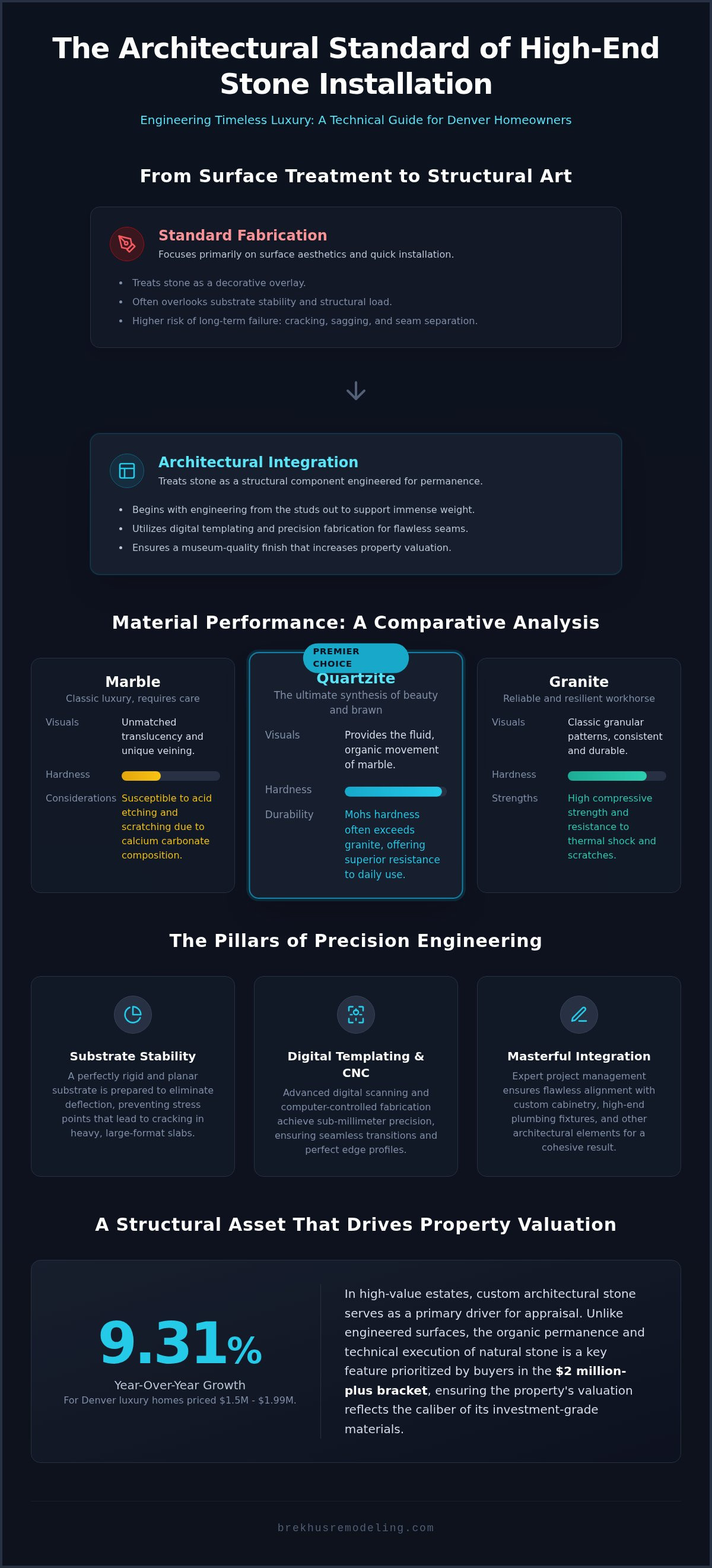
High-end stone installation Denver represents a precise synthesis between rare material selection and rigorous mechanical execution. While a standard countertop replacement focuses primarily on surface aesthetics, architectural stone integration treats the material as a structural component within the home's design. This discipline requires a deep understanding of Dimension Stone properties and how they interact with the unique environmental conditions of the Mountain West. Denver's luxury residential market increasingly demands this level of technical mastery to ensure that investment-grade materials maintain their integrity for decades.
Architectural integration differs from standard fabrication through its focus on the "how" of the build. It involves assessing the home's skeleton to support the immense weight of oversized slabs. This proactive approach prevents common failures such as fissure separation, improper drainage in wet areas, or the structural sagging that occurs when heavy stone is placed on inadequate framing. For the sophisticated homeowner, the goal is a seamless environment where the stone feels like a permanent part of the architecture rather than an after-thought.
Beyond the Surface: Why Precision Engineering Matters
Improper leveling is the primary cause of failure in large-format slab applications. When a substrate isn't perfectly planar, gravity creates stress points that eventually lead to visible cracking. High-end stone installation Denver requires a rigid substrate to eliminate deflection, which is especially critical in regions with expansive soil. We utilize high-grade epoxies and specialized setting materials that provide a permanent bond, resisting the mechanical vibrations that occur during residential use. This level of planning prevents common issues like "lippage" in tile work or the structural fatigue that compromises stone showers over time.
The Impact of Stone on Residential Property Value
The Denver luxury market continues to show resilience, with sales for homes priced between $1.5 million and $1.99 million growing by 9.31% year-over-year as of mid-2026. In these high-value estates, custom stone work in kitchens and bathrooms serves as a primary driver for appraisal. While engineered surfaces offer utility, natural stone provides a sense of organic permanence that buyers in the $2 million-plus bracket prioritize. The Brekhus Standard defines stone quality not merely by its visual appeal, but as a structural asset engineered to withstand the rigors of a high-performance home. Investing in architectural stone ensures that the property's valuation reflects the caliber of its technical execution and long-term durability.
Material Selection: Engineering Longevity into Luxury Surfaces
Successful high-end stone installation Denver begins with a rigorous assessment of mineralogy rather than mere aesthetics. Each stone type possesses distinct physical properties that dictate its suitability for specific residential applications. Marble remains a hallmark of luxury for its translucency and unique veining, yet its calcium carbonate composition makes it susceptible to acid etching and scratching. Granite offers a higher compressive strength and resistance to thermal shock, making it a reliable choice for high-traffic surfaces. Soapstone, being chemically inert, provides a matte texture and exceptional heat retention, though its relative softness requires a different approach to edge fabrication.
Quartzite has emerged as the premier material for sophisticated Denver interiors. It provides the fluid, organic movement of marble with a Mohs hardness rating that often exceeds granite. This makes it ideal for environments where visual prestige must coexist with daily utility. When selecting slabs, the distinction between 2cm and 3cm thickness is critical. A 3cm slab offers superior cantilever strength for oversized kitchen islands, while 2cm material often requires integrated plywood sub-tops to manage the load. Technical specifications for these applications are outlined in the Dimension Stone Design Manual, which serves as our baseline for structural compliance.
Natural Stone vs. Engineered Quartz: A Performance Analysis
Engineered quartz relies on petroleum-based resin binders that are sensitive to high heat and ultraviolet exposure. In sun-drenched Colorado rooms, these resins can degrade or discolor over time. Natural stone remains thermally stable and maintains its color integrity regardless of UV intensity. Bespoke architectural features, such as mitered "waterfall" edges or integrated stone sinks, achieve a higher level of refinement when executed in natural materials. For those planning custom kitchen installations, the material choice must account for long-term exposure to both heat and natural light to ensure the surface doesn't lose its luster.
Sourcing Premium Slabs for the Denver Environment
Denver’s semi-arid climate and dramatic temperature fluctuations present specific challenges for high-end stone installation Denver. Low humidity levels can affect the curing rates of high-performance sealants, while rapid shifts in ambient temperature cause microscopic expansion and contraction within the stone's pores. We inspect every slab for internal fissures and "dry seams" that could propagate into full fractures under these environmental stresses. Transporting fragile, oversized slabs to high-elevation project sites requires specialized vibration-dampening equipment. This prevents structural fatigue before the stone even reaches the fabrication floor, ensuring the final installation remains stable for the life of the home.
Structural Requirements for Large-Format Stone and Heavy Slabs
Precision in high-end stone installation Denver is fundamentally a matter of physics. A single 3cm quartzite slab can weigh upwards of 1,200 pounds, creating a concentrated dead load that standard residential framing is rarely designed to support without modification. Before a project begins, we evaluate floor joist capacity to ensure the structure can handle the weight of oversized kitchen islands or full-height stone showers. Failure to address these structural realities leads to deflection, which inevitably causes stone surfaces to crack or seams to separate over time. Professional stone integration requires reinforcing the home's skeleton to create a rigid, unyielding base for these premium materials.
Standard cabinetry often lacks the structural blocking and reinforced gussets necessary to support the vertical pressure of high-density stone. For floor-to-ceiling slab installations in modern bathrooms, the wall studs must be perfectly plumb and reinforced to prevent any lateral movement. This level of preparation is essential for maintaining the integrity of the stone, especially in Denver's climate where expansive soils can cause subtle shifts in a home's foundation. Adhering to the Natural Stone Institute Dimension Stone Design Manual ensures that every mechanical detail, from fastener spacing to adhesive selection, meets the highest industry standards for safety and longevity.
Substrate Preparation and Load-Bearing Considerations
Rigid substrate preparation is the only way to eliminate deflection in tile and slab work. In wet areas, we utilize cementitious backer units and advanced uncoupling membranes to isolate the stone from subfloor movement. When projects involve home extensions, the engineering must account for the specific weight of the chosen dimension stone. This technical rigor is part of a broader strategy for upgrading plumbing and electrical for a home remodel, ensuring the entire performance foundation is sound. We prioritize structural modifications at the start to prevent costly failures after the finish materials are set.
Managing Seams and Vein Matching for Visual Continuity
Visual continuity in high-end stone installation Denver relies on the art of the bookmatch. This process involves aligning the natural patterns of adjacent slabs to create a mirrored, symmetrical effect that appears as a single, continuous piece of stone. Achieving this requires digital templating technology to preview vein alignment before a single cut is made on the fabrication floor. Seam placement is never arbitrary. It's a calculated decision that balances structural stability with aesthetic invisibility. We position seams away from high-stress areas like sink cutouts, ensuring the installation remains as durable as it is visually striking. This meticulous approach transforms raw stone into a cohesive architectural statement.
The Technical Execution of High-End Stone Installation
Technical execution begins with high-fidelity data collection. Precision digital templating captures architectural nuances and wall irregularities that traditional analog tools often miss. This digital map ensures that every slab is cut to accommodate the specific geometry of the room, preventing gaps or forced fits during the final assembly. High-end stone installation Denver relies on this initial accuracy to facilitate a seamless integration between the stone and the home's permanent fixtures. Once the data is captured, it feeds directly into advanced CNC technology for fabrication. This allows for the creation of complex edge profiles and precise cutouts that maintain the material's structural integrity while achieving a bespoke aesthetic.
The installation process continues with an on-site dry fitting. This critical step allows us to verify vein continuity and seam alignment across multiple surfaces before any permanent bonding occurs. We utilize mechanical fastening systems in conjunction with high-performance adhesives to ensure absolute stability, especially for vertical applications or heavy overhanging elements. The final phase involves meticulous hand-polishing and the application of professional-grade impregnating sealers. These sealers penetrate the stone's pores to provide a deep level of protection against moisture and staining without altering the natural appearance of the surface.
Advanced Cutting and Edge Profile Engineering
Achieving the appearance of a massive, solid block requires the technical mastery of mitred edges. This involves cutting the stone at a precise 45-degree angle and joining the pieces with color-matched resins to create a continuous pattern wrap. Custom edge profiles, such as Ogee, Waterfall, or Cove, serve to define the design language of the space. A hallmark of premium craftsmanship is the polished underside of any stone overhang. This detail ensures that the tactile experience of the stone is as refined as its visual presentation, providing a finished feel that standard installations lack.
Specialized Waterproofing for Stone in Wet Areas
Installing natural stone in custom shower environments presents unique challenges regarding moisture management. We implement integrated drainage systems and precisely sloped stone floors to ensure efficient water evacuation and prevent efflorescence. The use of advanced waterproofing membranes behind the stone is non-negotiable for long-term durability. For a comprehensive analysis of these engineering requirements, consult our guide on architectural precision in custom shower installation. If you are ready to begin your renovation, contact us to schedule a consultation for your high-end stone installation Denver project.
Integrating Stone into Full-Scale Residential Remodels
Successful high-end stone installation Denver is not a standalone event. It's a critical phase within a larger architectural sequence. While a fabricator focuses strictly on the slab, a general contractor manages the complex dependencies that dictate the project's success. This includes the structural reinforcement of the floor system, the precision of the cabinetry installation, and the exact placement of mechanical rough-ins. When stone is treated as an isolated product, the risk of misalignment with other trades increases significantly. Professional integration ensures that the stone serves as a cohesive part of the home's architecture rather than a disconnected surface.
The Brekhus approach prioritizes methodical timeline management to protect your investment. We coordinate the installation to occur at the optimal phase, ensuring the stone is not exposed to the high-activity risks of early construction. In a recent Denver basement renovation, we utilized this end-to-end oversight to transform a standard subterranean space into a high-end living suite. This project required reinforcing the existing foundation to support a monolithic stone wet bar and managing complex plumbing integrations for a full-height stone shower. By controlling every variable from the studs out, we achieved a level of finish that a standalone fabricator simply cannot provide.
Coordinating Stone with Custom Kitchens and Premium Bathrooms
Precision at the interface of different materials is the hallmark of luxury. We manage the delicate coordination between stone backsplashes and electrical outlets to ensure that cutouts don't disrupt the natural flow of the veining. In premium bathrooms, plumbing rough-ins must align with surgical accuracy to accommodate stone vessel sinks and wall-mounted faucets. This prevents the need for on-site modifications that can compromise the stone's integrity. For a detailed analysis of how we engineer these complex environments, refer to our comprehensive guide to residential full remodels.
The Brekhus Standard: End-to-End Project Accountability
The Brekhus Standard provides a single point of accountability for the structural, mechanical, and finish work of your residence. This holistic oversight eliminates the communication failures that often occur between separate subcontractors. We take full responsibility for the technical integrity of the project, ensuring that the high-end stone installation Denver you envision is supported by a foundation of equal caliber. Our team manages the entire lifecycle of the material, from initial slab selection to the final hand-polish on site. Consult with Brekhus Remodeling for your high-end stone project to ensure your home meets the highest architectural standards for luxury and permanence.
Engineering Your Architectural Legacy in Stone
Achieving a museum-quality high-end stone installation Denver requires more than just selecting a premium slab; it demands a rigorous commitment to the structural engineering that supports it. You've seen how substrate stability, precision digital templating, and material mineralogy dictate the long-term success of a residence. By prioritizing technical integrity from the studs out, you ensure that your investment maintains its value and elegance despite Denver's environmental shifts. Luxury is found in the invisible details that prevent cracking and ensure seamless vein continuity across every architectural surface.
Established in 2004, Brekhus Remodeling specializes in high-end residential precision. We provide comprehensive technical support, including structural modifications and complex plumbing integrations, to handle rare materials and intricate architectural designs. Our team takes full responsibility for the outcome, delivering a result that stands as a testament to disciplined craftsmanship and professional rigor. Commission Your High-End Stone Transformation with Brekhus Remodeling to secure a partner who values technical excellence as much as you do. Your vision for a permanent, flawlessly executed home is within reach.
Frequently Asked Questions
How do I choose between marble and quartzite for my Denver kitchen?
Quartzite is the superior choice for high-traffic kitchens because it offers the aesthetic of natural marble with a hardness that exceeds granite. While marble is prized for its classic translucency, its calcium carbonate composition makes it highly susceptible to acid etching from common kitchen items like lemon juice or vinegar. Quartzite provides a more resilient surface that resists scratching and chemical reactions, making it ideal for homeowners who prioritize both visual prestige and long-term durability.
Is it necessary to reinforce my floor for a large stone kitchen island?
Structural reinforcement is almost always required for oversized stone islands because a standard 3cm slab can weigh over 1,200 pounds. This concentrated dead load often exceeds the capacity of standard residential floor joists, leading to deflection over time. We evaluate the home's framing to ensure it can support the weight without sagging, which is the primary cause of fractures in the stone and separation at the seams.
How long does a custom high-end stone installation typically take?
A custom high-end stone installation Denver typically requires a window of two to four weeks following the final digital templating. This timeline accounts for the advanced CNC fabrication, complex edge profile engineering, and meticulous hand-polishing required for a premium finish. Coordinating this phase within a full residential remodel ensures the stone is installed at the optimal time to prevent damage from other construction activities.
Can natural stone be used in a curbless walk-in shower?
Natural stone is an exceptional choice for curbless walk-in showers when the project includes a recessed structural floor and integrated drainage. The installation requires precise sloping of the stone slabs to manage moisture effectively and prevent water migration into the rest of the bathroom. This setup provides a seamless, museum-quality transition that enhances the architectural flow of a primary suite.
What is the best way to maintain the seal on high-end stone surfaces?
Maintain high-end stone surfaces by using professional-grade impregnating sealers and pH-neutral cleaners specifically formulated for natural stone. These sealers penetrate deep into the stone's pores to create a barrier against moisture and oils without changing the appearance of the finish. Depending on the stone's porosity and usage levels, we recommend reapplying the sealer every one to three years to ensure continued protection.
Why are mitred edges considered a premium feature in stone fabrication?
Mitred edges are considered a premium feature because they require advanced technical skill to create the appearance of a massive, solid block of stone. The process involves cutting the stone at a 45-degree angle and joining the pieces with color-matched resins to ensure the veining continues seamlessly around the edge. This technique adds significant visual weight and architectural sophistication to islands and countertops that standard edge profiles can't achieve.
How does Denver’s climate affect the longevity of natural stone?
Denver's semi-arid climate and rapid temperature shifts cause natural stone to expand and contract at a microscopic level. These environmental stresses can aggravate internal fissures or dry seams if the stone isn't properly reinforced during the installation process. We utilize high-performance bonding agents and rigid substrate preparation to mitigate these climate-induced movements and ensure the stone remains stable for the life of the home.
What is the difference between bookmatching and vein matching?
Bookmatching is the process of polishing two consecutive slabs so that their patterns mirror each other like an open book, creating a symmetrical focal point. Vein matching is a broader technique where we align the natural patterns across different surfaces, such as a countertop and a backsplash, to create a sense of continuous flow. Both methods rely on digital templating to preview the alignment before the stone is cut, ensuring a cohesive architectural statement.