How to Vet a General Contractor in Denver: The Master Craftsman’s Audit (2026)
Learn how to vet a general contractor Denver homeowners trust. Use our 2026 technical audit checklist covering codes, licensing, and structural integrity.

A successful six-figure renovation is not secured through a pleasant handshake or a collection of polished digital reviews. It is won through a technical audit of structural engineering discipline and administrative precision. Many homeowners in the Front Range market rightly fear the influx of unqualified operators who lack the local expertise to navigate complex urban code requirements. Understanding how to vet a general contractor Denver residents can trust for high-stakes projects requires looking beyond the surface level of a portfolio. It demands a rigorous investigation into professional standards and technical capabilities.
You recognize that a $100,000 investment deserves more than a vague estimate and a verbal promise. This guide provides the master craftsman's framework for auditing a contractor's professional integrity, from deciphering Denver license classes to verifying insurance limits that actually protect your asset. You'll gain a clear, technical checklist designed to separate high-performance builders from those who cut corners. We will examine the specific permitting hurdles of the 2026 Denver building code, the necessity of owner-operated oversight, and the indicators of true structural permanence in custom kitchens and premium bathroom expansions.
Key Takeaways
- Navigate Denver's specific 2026 licensing requirements and insurance thresholds to ensure full legal and financial protection for your high-value asset.
- Audit contractor portfolios for technical engineering complexity and structural discipline rather than superficial aesthetic finishes.
- Master how to vet a general contractor Denver requires for high-stakes renovations by prioritizing in-house technical expertise in plumbing, electrical, and stone installation.
- Apply a rigorous site-visit framework to evaluate the organizational discipline, safety standards, and real-time project management of active construction crews.
- Distinguish between superficial estimates and comprehensive feasibility studies to ensure total financial transparency and avoid unforeseen cost overruns.
Verifying Professional Credentials and Local Denver Licensing
Licensing in the City and County of Denver is more than a bureaucratic formality. It represents a legal baseline for safety and professional accountability. For high-stakes renovations, "licensed, bonded, and insured" serves as a basic entry requirement rather than a badge of distinction. True due diligence requires an understanding of how the Denver Community Planning and Development department categorizes technical capabilities. Learning how to vet a general contractor Denver residents trust involves verifying that the firm possesses the specific authority to execute your project's scope. This oversight ensures adherence to the 2026 Denver building codes and protects the structural integrity of your estate.
The core of general contractor responsibilities involves managing complex legal and technical risks. Without proper credentials, a homeowner assumes full liability for site accidents and code violations. Professional firms maintain active registration and expect clients to demand proof of status.
Understanding Denver License Classes: B vs. C
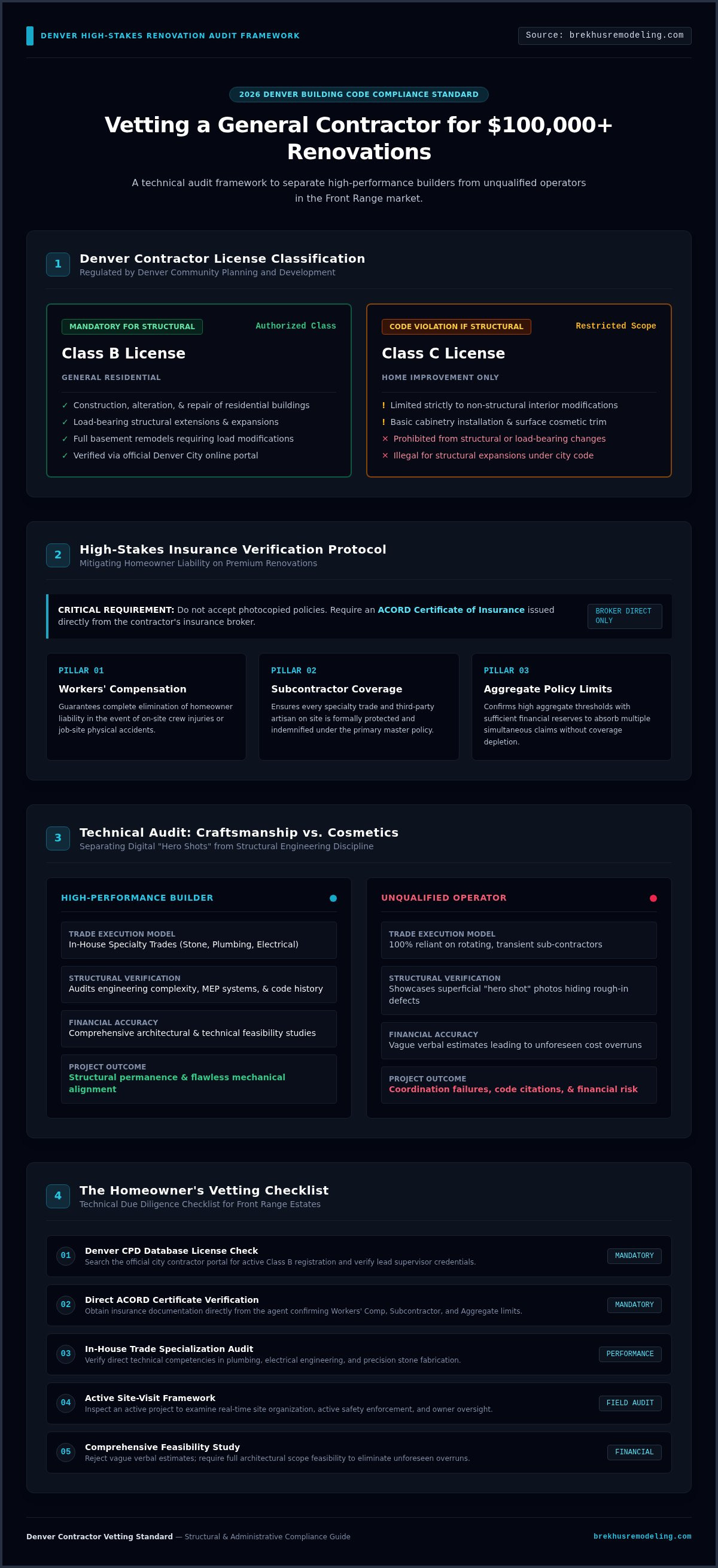
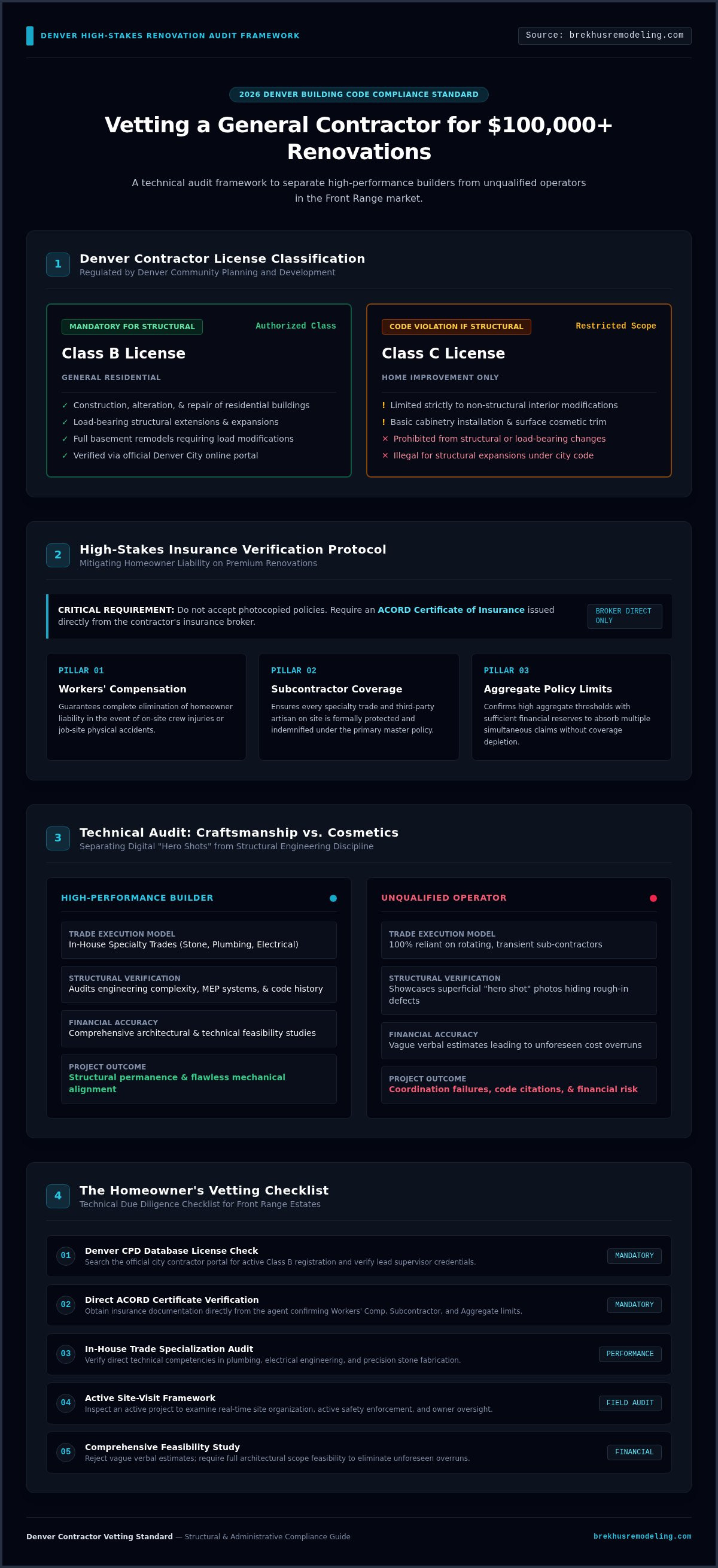
The distinction between license classes is critical for project legality. A Class B (General Residential) license allows for the construction, alteration, and repair of any residential building. This is mandatory for full home remodels, structural extensions, or basement finishes involving load-bearing changes. Conversely, a Class C (Home Improvement) license is restricted to non-structural work, such as interior finishes or cabinetry. Selecting a contractor with a Class C license for a structural expansion is a violation of city code. You can verify a firm's status in real-time through the Denver City online portal by searching the contractor's name or license number.
Insurance and Bonding Nuances for Premium Projects
Standard liability policies often fall short of the requirements for $100,000+ investments. High-end builds demand robust general liability limits to mitigate the risks associated with custom design-builds. Don't accept a photocopied certificate. You should request an ACORD certificate of insurance directly from the contractor's insurance agent. This ensures the policy is active and tailored to the project's scale. This level of scrutiny reflects a serious commitment to protecting your property and financial future.
Critical verification points include:
- Workers Compensation: Ensures you aren't liable for on-site injuries.
- Subcontractor Coverage: Verifies that all specialty trades are protected under the primary policy.
- Aggregate Limits: Confirms the policy has sufficient funds to cover multiple claims if necessary.
Evaluating Technical Mastery and Precision Craftsmanship
A portfolio of "hero shots" often masks the technical reality of a build. High-resolution photography captures the aesthetic appeal of a finished room, yet it reveals nothing about the structural or mechanical discipline beneath the surface. When determining how to vet a general contractor Denver homeowners must look for evidence of technical difficulty rather than just visual polish. This involves scrutinizing the complexity of past projects, such as the precision required for upgrading plumbing and electrical for a home remodel in historic neighborhoods. Before engaging a firm, utilize the official Denver contractor license search to ensure the lead supervisor possesses the technical credentials for high-performance residential work.
In-house expertise in specialty trades like stone fabrication and electrical engineering provides a significant advantage. It eliminates the coordination failures often found in projects that rely entirely on a rotating cast of transient subcontractors. Firms that prioritize these internal capabilities deliver a level of structural permanence that external teams rarely match. If you're planning a high-stakes renovation, reviewing the high-end remodeling finishes of an established specialist can clarify these technical expectations.
The Audit of Specialized Trade Integration
A master craftsman understands that luxury is a function of engineering. This is most evident in custom shower installations where waterproofing systems must be flawlessly executed to prevent long-term failure. You should audit a contractor’s ability to integrate high-end kitchen appliances with millimeter-precision cabinetry scribing. These details define the standard of excellence and separate professional builds from standard renovations. Precise execution in stone and tile installation requires a deep understanding of substrate preparation and adhesive chemistry.
Structural Integrity in Denver’s Unique Soil
Denver’s geological profile presents specific challenges, particularly the expansive clay soils that can compromise foundation integrity. Knowing how to vet a general contractor Denver requires for these conditions involves confirming their experience with moisture mitigation and foundation protection. Ask about their protocols for floating walls in basements and their collaboration with structural engineers for load-bearing modifications. Vetting a home remodeling contractor on these points ensures your investment is built on a stable foundation.
Auditing Project Management and Financial Transparency
Professional management is the administrative engine of a successful build. Without a structured project management system like Buildertrend or CoConstruct, high-stakes renovations often succumb to communication breakdowns and logistical delays. When determining how to vet a general contractor Denver homeowners should prioritize firms that provide real-time access to scheduling, daily logs, and financial documentation. This digital transparency ensures that every phase of the project remains visible and accountable. A firm's ability to manage data is as critical as its ability to manage a job site.
Financial integrity begins with a comprehensive feasibility study rather than a preliminary "guesstimate." A professional audit identifies potential structural or mechanical constraints before any demolition occurs. Following FTC guidance on hiring home improvement contractors, you should ensure that the payment schedule is tied to specific, verifiable milestones rather than arbitrary dates. This approach mitigates financial risk and aligns the contractor’s interests with the project's progress. Reliable partners don't hide behind vague numbers; they provide clarity through detailed documentation.
Firm Estimates vs. Loose Allowances
Vague allowances are a common tactic used to present a lower initial bid. These placeholders for materials or labor frequently result in significant cost overruns once the actual selections are made. A rigorous line-item budget for a bathroom renovation should account for every technical detail, including high-performance waterproofing and precision plumbing fixtures. You must confirm that technical support for plumbing and electrical is integrated into the primary scope. This prevents the coordination failures and hidden fees that arise when these critical trades are treated as secondary considerations.
The Pre-Construction Feasibility Process
A disciplined pre-construction phase is the most effective defense against timeline slippage in Denver’s competitive market. This process must include a multi-layered analysis of structural, mechanical, and aesthetic requirements. By identifying hidden costs, such as antiquated wiring or sub-floor irregularities, early in the planning stage, a contractor can finalize a firm price that remains stable throughout the build. This methodical preparation transforms a complex renovation from a series of reactive corrections into a controlled, professional execution. True mastery is found in the planning, not just the assembly.
The Site Visit and Reference Interview Framework
A finished showroom represents a contractor's best day under ideal conditions. An active construction site represents their standard operating procedure. When determining how to vet a general contractor Denver residents can rely on for high-stakes builds, a physical inspection of a project in progress is mandatory. This visit allows you to observe the technical discipline that professional photography cannot capture. You are looking for a controlled environment that reflects administrative precision and respect for the property. A site that is disorganized or hazardous is a leading indicator of how your own home will be treated during the renovation process.
The "culture of the site" provides immediate insight into the firm's leadership. High-performance crews operate with a sense of order, maintaining clear pathways and secured materials. This level of site management is essential for preserving the integrity of the existing structure and ensuring the safety of everyone involved. If the site is chaotic, the management of your budget and timeline will likely follow the same pattern.
Active Site Visit Checklist
Professionalism is visible in the technical details of site protection. In occupied luxury renovations, dust mitigation systems and heavy-duty floor protection, such as reinforced surface shields, are non-negotiable standards. You should assess the organization of the rough-in work before it is hidden behind drywall. Ensure that plumbing lines and electrical runs are secured with engineering-grade accuracy and follow a logical, clean layout. A chaotic rough-in often signals a lack of technical oversight. Verify the presence of the lead superintendent or the owner-operator during your visit. Their active involvement ensures that the standards established during the pre-construction phase are maintained through every phase of the build.
The Sophisticated Reference Interview
Reference checks for six-figure projects must move beyond superficial satisfaction. You should prioritize speaking with clients whose projects were completed at least three years ago. This interval reveals the true longevity of the work and the contractor's commitment to structural permanence. Ask specific questions about the "messy middle" of the construction process. How did the firm respond to a supply chain delay or an unforeseen structural condition? Inquire about the performance of the finishes over time. Are the large-format stone tiles still perfectly level? Is the custom plumbing silent and efficient? This level of inquiry separates temporary cosmetic fixes from long-term architectural value. Verifying how change orders were managed will also reveal the contractor's commitment to financial transparency.
Vetting a partner for your home requires this level of rigor to ensure your investment is protected. If you are ready to discuss a project defined by technical integrity and professional oversight, schedule a consultation with Brekhus Remodeling to review our professional standards.
Selecting Brekhus Remodeling: The Benchmark for Denver Estates
Establishing a standard for structural permanence requires a departure from the industry's reliance on superficial aesthetics. Since 2004, Brekhus Remodeling has operated with an engineering-first philosophy that prioritizes the technical integrity of the build over cosmetic fluff. When determining how to vet a general contractor Denver residents should look for a firm that treats every renovation as a complex architectural challenge. Our legacy in the Front Range is built on a disciplined approach to high-stakes residential projects, ensuring that every custom kitchen and full home extension meets a professional caliber of excellence. We don't just manage projects; we engineer them for longevity.
Discerning homeowners recognize that a luxury home exterior makeover or a complex interior remodel requires more than a visionary design. It demands an owner-operated firm that takes full responsibility for the outcome. By maintaining a strictly residential focus, we've refined our understanding of local home systems and the specific environmental demands of the Denver climate. This specialized expertise allows us to navigate the most rigorous auditing processes with unwavering confidence.
End-to-End Precision
The most common cause of project failure is the coordination gap between disparate subcontractors. We eliminate this risk by providing end-to-end technical support through in-house master tradesmen. Our team handles the critical mechanics of plumbing, electrical, and stone installation, ensuring that every component of the build is integrated with millimeter precision. This internal control allows us to maintain a level of technical rigor that transient crews cannot replicate. Whether we are executing a custom shower install or a full basement transformation, our commitment to craftsmanship is backed by decades of active, on-site experience.
The Next Steps in Your Renovation Journey
A successful build begins with a technical consultation designed to establish the scope and feasibility of your vision. This initial discovery session is a professional audit of your project's requirements, from structural modifications to mechanical upgrades. To prepare for this session, you should have your architectural goals defined and any existing site plans available for review. This methodical approach ensures that our partnership is founded on transparency and shared technical expectations. If you're ready to secure a partner who values structural integrity as much as you do, consult with a Brekhus Remodeling specialist today to begin your project's master craftsman's audit.
Securing Your Estate’s Structural Legacy
A high-stakes renovation requires more than a vision; it demands a technical partnership rooted in engineering discipline. Mastering how to vet a general contractor Denver homeowners can trust involves looking past the portfolio to the administrative and structural systems that support the build. You now have the framework to audit licensing classes, verify insurance limits, and evaluate on-site organizational standards. These rigorous checks ensure that your investment is protected by professional oversight rather than verbal promises.
Brekhus Remodeling has served the local residential community since 2004, providing a benchmark for precision in custom kitchens and premium bathrooms. Our model eliminates the coordination gap through specialized in-house stone mastery and comprehensive plumbing and electrical integration. This level of technical rigor is the foundation of structural permanence. When you're ready to advance your project with a partner committed to excellence, Secure Your Professional Consultation with Brekhus Remodeling. Your home deserves the standard of a master craftsman.
Professional Standards and Frequently Asked Questions
How do I verify if a general contractor is licensed in Denver?
You verify a license through the City and County of Denver’s official Contractor License Search portal. This real-time database allows you to confirm a firm's active status and the specific supervisor credentials attached to the business. It's essential to ensure the license matches the business name on your contract. Cross-referencing this data with the Secretary of State's records provides an additional layer of professional verification for local operations.
What is the difference between a Class B and Class C license in Colorado?
A Class B license permits structural work on residential buildings, including home extensions and load-bearing modifications. A Class C license is restricted to non-structural improvements such as cabinetry, flooring, or interior finishes. For a full remodel involving structural changes, a Class B supervisor is legally required in Denver. Understanding these distinctions is a core part of learning how to vet a general contractor Denver homeowners can trust with complex engineering requirements.
Should I hire a general contractor or a specialized subcontractor for a bathroom remodel?
A general contractor is necessary for any bathroom remodel involving multiple trades such as plumbing, electrical, and stone installation. While a specialized subcontractor might handle a single task, a general contractor manages the critical trade coordination and permitting process. This oversight prevents the coordination gap that often leads to waterproofing failures or code violations. Firms with in-house technical support provide the highest level of structural integrity for these high-moisture environments.
How much insurance should a Denver general contractor carry for a luxury renovation?
A professional contractor for luxury renovations should carry a minimum of $1 million per occurrence and $2 million aggregate in general liability insurance. High-value estates often require higher limits or umbrella policies to fully mitigate risk. You must also verify active workers' compensation coverage for all on-site personnel. Request an ACORD certificate directly from the insurance agent to confirm the policy is active and sufficient for your specific project scope.
What are the red flags to look for during a contractor interview?
Red flags include the use of vague allowances instead of firm line-item pricing and a lack of dedicated project management software. If a contractor hesitates to provide active job site references or lacks a permanent physical office, it suggests a lack of professional stability. Another warning sign is a contractor who minimizes the importance of Denver’s permitting process or requests a large cash deposit before providing a detailed feasibility study or schedule.
How long does a typical full home remodel take in Denver in 2026?
The duration of a full home remodel depends on structural complexity and the permitting timeline of the Denver building department. While every project is unique, comprehensive renovations often span six to twelve months from the start of demolition to final inspection. Factors such as custom stone fabrication and specialty electrical upgrades can influence this window. A professional firm will provide a detailed critical-path schedule during the pre-construction phase to ensure timeline transparency.
Do I need a permit for an interior remodel in the City of Denver?
Permits are required for most interior remodels in Denver that involve structural changes, plumbing modifications, or electrical upgrades. The City and County of Denver strictly enforces code compliance to ensure residential safety and long-term property value. Even non-structural work, such as water heater replacements or basement finishing, typically requires specific trade permits. Professional contractors handle the entire permitting process, ensuring all inspections are documented and finalized according to 2026 standards.
Why is a firm estimate better than a cost-plus contract for residential work?
A firm estimate provides financial predictability by establishing a fixed price based on a detailed scope of work. This model protects homeowners from the budget volatility common in cost-plus contracts, where labor and material fluctuations can lead to unforeseen expenses. Learning how to vet a general contractor Denver residents rely on involves prioritizing firms that conduct thorough pre-construction audits. This rigorous planning allows for precise pricing that accounts for technical requirements before the project begins.