Luxury Home Renovation ROI: A Smarter Framework for 2026
Maximize your luxury home renovation ROI with our 2026 framework. Balance resale value, long-term comfort, and smart scope decisions before you remodel.

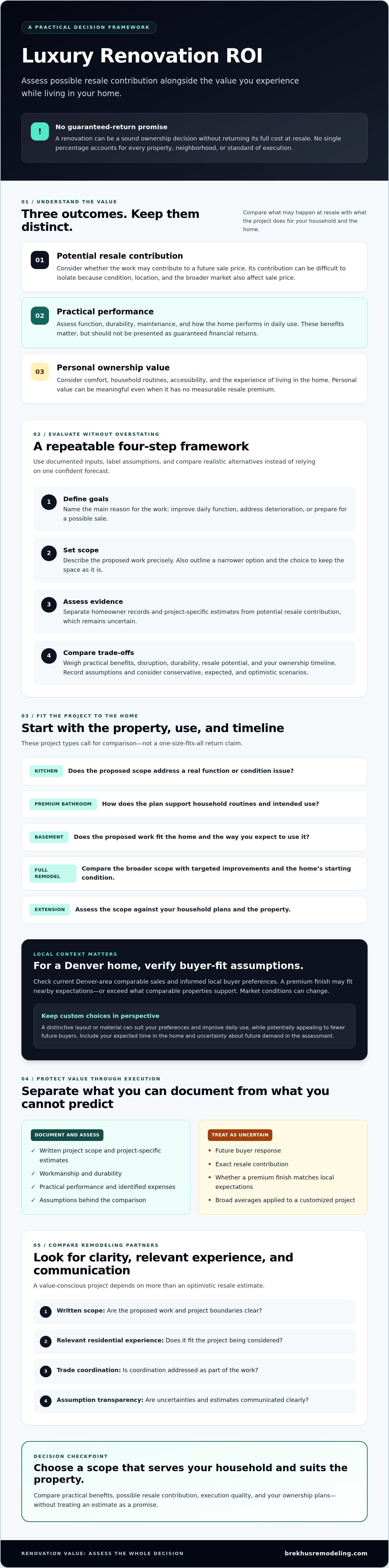
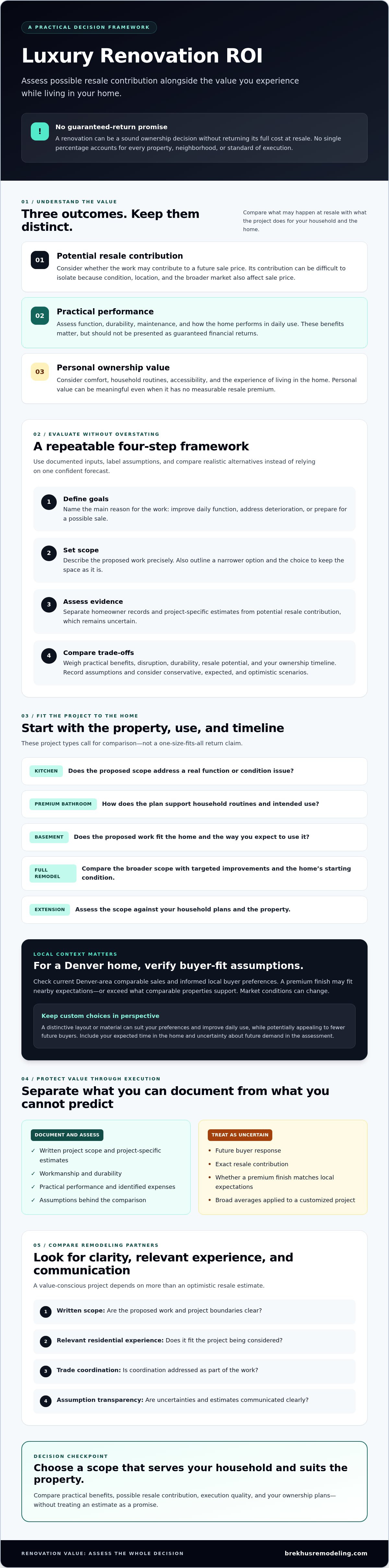
An expensive renovation can be a sound ownership decision without returning its full cost at resale. A useful luxury home renovation ROI assessment weighs potential resale contribution alongside comfort, function, maintenance, and how long you expect to stay. No single percentage can account for every property, neighborhood, or standard of execution.
Before committing to a premium kitchen, bathroom, or full remodel, separate benefits a future buyer may recognize from the ones you’ll experience while living in the home. Also consider whether the project’s scope and finishes fit local expectations. In Denver, check current comparable sales and buyer preferences rather than assuming a particular upgrade will pay off.
This article offers a consistent framework for comparing projects by potential financial contribution, long-term performance, ownership plans, and execution quality. It also highlights assumptions to verify with local market professionals, contractors, or the relevant authorities. Whether you’re considering a focused upgrade, a broader remodel, or a home extension, the goal is a scope that serves your household and suits the property, without relying on a guaranteed-return promise.
Key Takeaways
- Define success before comparing projects. Consider what you can assess during ownership as well as possible resale contribution.
- Use a consistent four-step process to set goals, define scope, review evidence, and weigh trade-offs. Treat estimates as uncertain, not guaranteed outcomes.
- Assess kitchens, premium bathrooms, basements, full remodels, and extensions against your property, intended use, and ownership timeline.
- Separate documented workmanship and durability from uncertain claims about future buyer response.
- Compare remodeling partners by the clarity of their written scope, relevant residential experience, trade coordination, and communication about assumptions.
What Luxury Home Renovation ROI Really Measures
Luxury home renovation ROI compares a project’s investment with its potential financial contribution and practical benefits during ownership. It does not mean the homeowner is guaranteed to recover the project cost at resale.
A renovation is a process of improving a structure, but improvement can be measured in more than one way. A resale-focused estimate considers whether the work may contribute to a future sale price. An ownership-focused assessment looks at how the home functions, feels, and performs while you live there. These measures are related, but they are not interchangeable.
Financial return and ownership value are not the same
Resale contribution is one possible outcome, not the only measure of value. For a financial comparison, consider the project investment alongside a defensible estimate of the value attributable to the renovation. That value can be difficult to isolate because the home’s condition, location, and broader market also affect its sale price.
Assess practical benefits separately. A kitchen layout that makes meal preparation easier, a bathroom that better supports household routines, or durable flooring suited to daily use may improve your experience without producing a measurable resale premium. Reduced maintenance or improved accessibility may also matter to your household, but don’t present those personal benefits as guaranteed financial returns.
Why luxury renovation returns vary by property
The same scope can mean different things in different homes. Updating a worn kitchen is not the same as replacing one that already functions well. A full remodel also differs from targeted improvements. Comparisons are useful only when you understand the home’s starting condition, project boundaries, and execution standard.
Local buyer expectations matter, too. A premium finish may fit nearby homes and buyer demand, or it may exceed what comparable properties support. Check that assumption against current Denver-area comparable sales and informed local market guidance. A broad estimate or automated home-value tool may not account for a customized project, and market conditions can change.
Custom choices involve another trade-off. A distinctive shower, kitchen layout, or material selection may suit your preferences and improve daily use, yet appeal to fewer future buyers. That doesn’t automatically make it a poor decision. Include both your expected time in the home and the uncertainty of future demand in your assessment.
A disciplined luxury home renovation ROI assessment keeps three outcomes distinct: potential resale contribution, practical performance, and personal ownership value. Evaluate each on its own terms before deciding whether the project’s scope and execution standard suit the property and your plans.
How to Evaluate Luxury Home Renovation ROI Without Overstating It
A reliable comparison starts with documented inputs and clearly labeled assumptions. Evaluating luxury home renovation ROI doesn’t require pretending resale value can be predicted precisely. It means using a consistent method to compare the project with realistic alternatives, expected ownership benefits, and uncertainty.
Use a repeatable four-step framework
- Define goals. Identify the main reason for the work, such as improving daily function, addressing deterioration, or preparing for a possible sale.
- Set scope. Describe the proposed work precisely, then outline a narrower option and the choice to keep the space as it is. Make clear what each alternative includes.
- Assess evidence. Separate inputs supported by homeowner records or project-specific estimates from potential resale contribution, which remains uncertain.
- Compare trade-offs. Weigh practical benefits, disruption, durability, and resale potential against your ownership timeline. Record assumptions and consider conservative, expected, and optimistic scenarios instead of relying on a single forecast.
Build a project-specific comparison
Use estimates for your home and proposed scope. List inputs you can document, such as the project estimate you received and any other expenses you’ve identified. National averages and promotional figures are not substitutes for project-specific information.
Then describe potential benefits without forcing them into a dollar value. A custom kitchen might address a layout problem; a premium bathroom could improve daily use; a full remodel may resolve several condition or function concerns. Note possible effects on condition, durability, maintenance, and buyer appeal separately. Compare those outcomes with what might happen if you defer the work or choose a more focused scope.
Check the evidence behind value claims
Give the most weight to current, geographically relevant evidence. For Denver, comparable properties are useful only when their location, condition, features, and renovation scope meaningfully resemble the home you’re evaluating. A broad market estimate may provide context, but it cannot establish the resale contribution of a customized project on its own.
For published benchmarks, note the source, publication date, geography, methodology, and project definition. A report may describe a different market or scope than yours. The NAR's Remodeling Impact Report, for example, includes a homeowner-reported Joy Score alongside remodeling information. Treat that nonfinancial measure separately from a financial return estimate.
Keep your comparison transparent: label what is documented, what is estimated, and what is personal judgment. For a Denver project, discussing scope and execution with a residential remodeling professional can help clarify project-specific assumptions. Explore Denver remodeling services as one starting point for that conversation.
Which Luxury Renovations May Fit Your Goals and Denver Home?
The right project depends on what the home lacks and how you plan to use it, not on a universal ranking of upgrades. A kitchen renovation may solve a workflow problem; an extension may create needed space. Neither automatically returns its full investment at resale. A project can deliver meaningful value to its owners even when future buyers don’t value it the same way.
Use the comparison below to decide what to investigate before setting the scope. The evidence column is a starting point, not a promise of resale performance.
| Project | Intended benefit | Evidence to gather | Uncertainty | Ownership fit |
|---|---|---|---|---|
| Custom kitchen | Improve layout, workflow, condition, or household use. | Current layout constraints, condition, and features in comparable nearby homes. | Buyer appeal depends on local expectations and design choices. | Owners who use the kitchen often or plan to stay long enough to benefit from better function. |
| Premium bathroom | Improve daily function, installation quality, durability, or design fit. | Existing condition, household needs, and the quality and scope of proposed work. | Personalized finishes may not suit every buyer. | Owners prioritizing reliable daily use and a bathroom aligned with their needs. |
| Full remodel | Address connected issues across multiple rooms or improve how the home works as a whole. | Condition and layout of the spaces involved, plus relevant nearby properties. | Broader scope makes it harder to isolate which changes may influence resale. | Owners whose needs extend beyond a single room and who expect to use the improvements. |
| Basement | Make existing lower-level space more useful for household activities. | Current condition, intended use, and how similar homes present comparable space. | Usefulness and buyer response may vary with the home and local preferences. | Owners with a clear, ongoing purpose for the additional usable space. |
| Home extension | Add space when the existing footprint limits intended use. | Household needs, property constraints, proposed scope, and relevant local comparisons. | Added space alone doesn’t establish a matching resale contribution. | Owners who need more room and expect to remain in the home. |
Match scope to the property and neighborhood
Start with the problem the project should solve. Correcting a functional or condition issue differs from adding highly individualized features mainly for personal taste. Both can be valid, but they involve different resale uncertainties. Separate essential work from optional design decisions so you can evaluate each on its own.
In Denver, don’t treat the market as uniform. Compare the proposed scale and finishes with current, genuinely similar nearby homes, considering location, property type, condition, and features. A finish level that suits one neighborhood or home may be out of step elsewhere. Local evidence can inform buyer appeal, but it can’t guarantee that you’ll recover the renovation investment.
A disciplined luxury home renovation ROI decision balances the home’s constraints, the owner’s intended use, and verified local context. Choose a scope for the outcome that matters most, while treating resale contribution as a possibility to assess, not a certainty.
How Planning and Craftsmanship Can Protect Renovation Value
Careful execution can protect a renovation’s quality and usefulness, but it can’t guarantee what a future buyer will pay. In a sound luxury home renovation ROI assessment, distinguish what you can verify about scope and workmanship from resale estimates that depend on future market conditions. Clear planning helps reduce avoidable uncertainty before work begins.
Control uncertainty before construction begins
Document the project’s priorities, boundaries, finish selections, and decision responsibilities. Identify what is included, what is excluded, and how proposed changes will be reviewed and recorded. This shared reference helps homeowners and contractors assess revisions against the intended result and spot scope changes before they go unnoticed.
Plan connected work as a sequence. A kitchen or bathroom renovation may involve plumbing, electrical, and finish installation, while a broader remodel can require coordination across several rooms. Discuss how trades will be scheduled, how one phase affects another, and who will communicate decisions. Confirm project-specific permit and code questions with the appropriate local authority before work proceeds. Requirements depend on the details of the work, so don’t rely on assumptions.
Assess execution standards, not just design intent
A finish schedule describes what the homeowner wants to see. The project plan should also explain how the work will be carried out and reviewed. For custom showers, tile, stone, and flooring, discuss material selections, installation sequence, transitions, and how completed work will be checked against the agreed scope. These details help you assess workmanship and expected durability. They are not evidence of a guaranteed resale premium.
Ask prospective contractors how they coordinate residential trades, document decisions, and communicate scope changes. For plumbing or electrical work, clarify how the planned work connects with finish installation and which project-specific requirements need confirmation. Coordination helps align design intent with technical execution.
Review finish choices deliberately. Consider how appearance and material selection suit the home, intended use, and maintenance expectations. If plumbing or electrical work is part of the remodel, understand how those systems relate to the wider project scope.
Before choosing a contractor, request a written description of the proposed scope and how changes will be handled. Discuss a coordinated Denver remodeling project to consider how a kitchen, premium bathroom, or full remodel could be planned around your property and ownership goals.
Choosing a Denver Remodeling Partner for a Value-Conscious Project
A contractor proposal should help you evaluate the project, not rely on a headline promise about resale value. For a sound luxury home renovation ROI decision, compare how clearly each partner connects the home’s existing condition, your priorities, and the proposed work. Treat market-value claims as assumptions to verify, not guaranteed outcomes.
Questions to ask before comparing proposals
Use the same checklist with each prospective contractor. Specific answers make differences in scope and execution easier to identify.
- Scope and existing conditions: How does the proposed work address the home’s current condition and your stated goals? What is excluded or depends on further assessment?
- Relevant residential experience: Has the contractor completed projects with a similar scope, such as custom kitchens, premium bathrooms, full remodels, or home extensions? Ask how the example relates to your property rather than assuming every project is directly comparable.
- Trade coordination: Which residential trades and specialized installations are included or coordinated? Clarify how plumbing, electrical, tile, stone, or flooring work fits into the overall sequence.
- Selections and changes: How are finish selections, project assumptions, exclusions, and revisions documented? Confirm how scope changes are communicated and approved.
- Value claims: What evidence supports any resale estimate, and which local market assumptions remain unverified? Check comparable sales and buyer preferences against current, relevant Denver-area sources.
Turn your ROI framework into a project brief
Before requesting or reviewing proposals, prepare a concise brief that records why you’re renovating, how long you expect to own the home, which outcomes matter most, and what scope alternatives you would consider. Separate must-haves, optional features, and personal preferences. Include homeowner-provided estimates or other documented project inputs, and label resale projections as uncertain.
Compare proposals for completeness, coordination, and clarity, not just their summary claims. Check whether each addresses the same rooms, selections, assumptions, and exclusions. A narrower scope may serve your goals better than a broader plan. A more extensive project may make sense when several parts of the home need to work together. For a project spanning multiple spaces, consider how the full remodel will address those areas as a whole.
Brekhus Remodeling serves Denver homeowners with custom kitchens, premium bathrooms, full remodels, basements, and home extensions, as well as specialized tile, stone, and flooring installation. These services may suit a project that needs coordinated residential work. The right scope depends on the home and your priorities. Discussing the proposed work with a Denver residential remodeler can help clarify what it involves, without treating a future resale return as certain.
Make Your Next Renovation Decision With Confidence
A strong renovation decision starts with a clear purpose, a defined scope, and evidence suited to your specific Denver home. Evaluate possible resale contribution separately from the comfort, function, and durability you expect during ownership. Then review project assumptions carefully. Even well-executed work can’t guarantee recovery of its full investment at resale.
A disciplined luxury home renovation ROI framework helps you choose a project that fits your property and ownership plans instead of relying on a universal return estimate. Clear communication and coordinated execution can support the intended result, whether you’re planning a custom kitchen, premium bathroom, full remodel, or extension.
Brekhus Remodeling serves Denver homeowners with premium bathrooms, custom kitchens, full remodels, and extensions, including specialized custom shower, tile, stone, and flooring installation. If you’re ready to discuss a possible scope, discuss your Denver renovation goals with Brekhus Remodeling.
Frequently Asked Questions
What does luxury home renovation ROI mean?
Luxury home renovation ROI compares a project’s investment with its potential financial and practical outcomes. Resale recovery is one measure; improved function, condition, or durability may also matter during ownership. A resale estimate depends on the property’s starting condition, local demand, project scope, and execution. No calculation can guarantee a future sale price or ensure you’ll recover the full investment, including in Denver’s changing housing market.
Does a luxury home renovation always increase resale value?
No. A renovation may improve a home’s condition, function, or appeal to buyers, but it doesn’t ensure a higher sale price. Outcomes depend on the property, workmanship, buyer preferences, and comparable homes in the relevant Denver area. Before relying on a value claim, check current local evidence and how the comparison was made. National averages and promotional statements may not reflect your home, neighborhood, or specific renovation.
Which luxury home renovations tend to have the strongest ROI?
There’s no universally strongest project without current, relevant evidence for the property and market. A custom kitchen may address layout or condition, while a premium bathroom may better support household routines. A full remodel or extension may suit owners whose needs span multiple spaces or require more room. Compare each option’s condition-related needs, intended use, scope, fit with local buyers, and how long you expect to own the home.
How do I calculate the ROI of a home renovation?
Start by defining the project scope and gathering project-specific investment figures. Then assess possible resale contribution separately from practical benefits. Compare resale assumptions with current, relevant evidence for similar Denver-area properties. Record the source, date, and assumptions behind each estimate, and consider conservative, expected, and optimistic scenarios. Treat the result as an informed estimate, not a guaranteed percentage or a promise that the sale price will cover your investment.
Is a luxury renovation worth it if I plan to stay in my home?
It can be worthwhile if the project supports how you expect to live in the home, even when near-term resale isn’t the priority. Consider how often you’ll use the improved space and whether the scope addresses meaningful needs, such as a more functional kitchen or a bathroom better suited to your household. Assess comfort, durability, and daily usefulness as ownership benefits, not guaranteed financial returns.
Does location affect luxury home renovation ROI in Denver?
Yes. Location can influence comparable sales, buyer expectations, and which improvements fit nearby homes, but Denver isn’t one uniform market. Compare recent properties with similar locations, property types, conditions, and features. Confirm that the evidence reflects current conditions and a comparable renovation scope. Don’t apply assumptions from another neighborhood or housing type without checking them, since local buyer preferences and market conditions can differ.