Luxury Kitchen Cabinet Design: The Intersection of Engineering and Artistry (2026)
True luxury kitchen cabinet design is more than looks. Explore the 2026 guide to superior engineering, materials, and artistry for a lasting investment.
The most expensive cabinetry on the market is a failed investment if it cannot withstand the atmospheric demands of its environment. You recognize that true luxury kitchen cabinet design is defined by structural integrity rather than mere aesthetic trends. In Denver's arid climate, the margin for error remains thin. Cabinets must function as a high-performance workspace while serving as a permanent structural asset to the property.
Distinguishing between deceptive marketing jargon and genuine custom engineering is essential for a successful renovation. You deserve a kitchen where stone, tile, and high-end appliances integrate with surgical precision. This article outlines the technical and aesthetic standards required to transform your space into an architectural masterpiece. We will detail the coordination of plumbing and electrical systems, the selection of resilient materials, and the rigorous assembly methods that ensure long-term reliability.
Key Takeaways
- Identify the technical benchmarks of superior construction, including the load-bearing advantages of dovetail joinery and 3/4-inch Grade A plywood.
- Select resilient materials and wood species specifically engineered to remain stable and avoid warping in the arid Denver climate.
- Navigate the 2026 aesthetic landscape, from the saturated color palettes of 'Jewel-Box' kitchens to the high-performance functionality of handle-less systems.
- Execute a seamless luxury kitchen cabinet design by coordinating structural cabinetry with heavy stone surfaces and integrated appliance panels.
- Understand why rigorous plumbing and electrical planning is critical to support the long-term performance of high-end kitchen workspaces.
Defining Luxury Kitchen Cabinet Design: Beyond Aesthetics
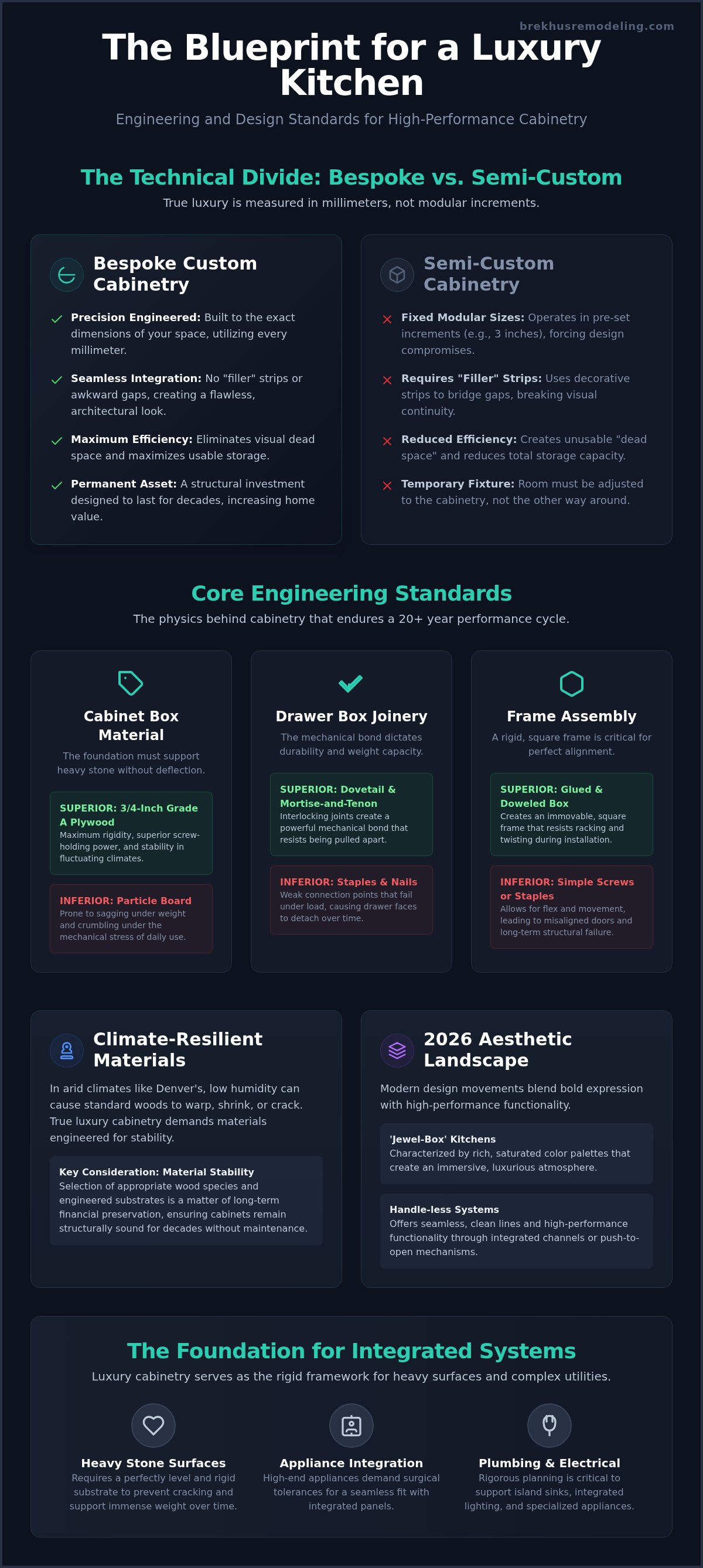
High-performance luxury kitchen cabinet design is a discipline of engineering rather than a mere selection of finishes. While standard kitchen cabinet construction often relies on mass-produced dimensions and decorative veneers to mask structural shortcuts, luxury cabinetry functions as a bespoke architectural feat. It prioritizes structural logic over superficial trends. Every unit is designed to serve as a permanent asset to the home, specifically tailored to the unique spatial requirements of high-value Denver estates.
The engineering must precede the aesthetic choice. This means the hardware, joinery, and material stability dictate the eventual look of the kitchen, not the other way around. Professional-grade cabinetry must support the immense weight of premium stone countertops without any deflection over time. It must also accommodate the surgical tolerances required for high-end appliance integration. When a project is approached with this level of technical rigor, the cabinetry becomes the structural foundation of the entire renovation.
Bespoke vs. Semi-Custom: The Technical Divide
The distinction between true custom-made cabinets and high-end semi-custom alternatives is found in the technical execution. Semi-custom options operate within the constraints of fixed-size modular boxes, usually in three-inch increments. This inevitably requires the use of "fillers" or decorative strips to bridge gaps between the cabinet and the wall. This creates visual dead space and reduces overall storage efficiency. Bespoke design utilizes every millimeter of architectural space. It allows for seamless floor-to-ceiling integration and precise alignment with structural pillars or windows. There are no compromises in fitment; the cabinetry is built to the room, rather than the room being adjusted to the cabinetry.
The Value of Structural Permanence
True luxury is measured by a lack of maintenance requirements over a 20-year performance cycle. In the Denver climate, where low humidity can cause standard materials to warp, shrink, or crack, the choice of substrate and joinery becomes a matter of long-term financial preservation. Cabinets should serve as a permanent structural investment that increases the home's valuation. This level of planning is a core component of The Comprehensive Guide to Residential Full Remodels, where cabinetry acts as the rigid framework for heavy stone surfaces and integrated technical systems. By treating cabinetry as a permanent installation rather than a temporary fixture, you ensure the kitchen functions as a high-performance workspace for decades.
The Engineering Standards of High-End Cabinetry
Superior luxury kitchen cabinet design relies on the physics of load-bearing capacity and material stability. While entry-level cabinetry often utilizes thin particle board, high-end engineering demands 3/4-inch Grade A plywood. This substrate provides the necessary rigidity to support heavy stone countertops without deflection. Particle board lacks the long-term screw-holding power required for heavy-duty hinges and drawer slides; it eventually crumbles under the mechanical stress of daily use. In contrast, multi-layered plywood remains stable in fluctuating environments, ensuring the cabinetry doesn't sag or lose its alignment over a 20-year cycle.
Structural integrity is further defined by the precision of the assembly. The benchmark for premium construction is a glued and doweled box, which creates a rigid, square frame that resists racking during installation. When planning a luxury kitchen cabinet design, the hardware must be rated for the specific weight of custom-milled solid wood doors. This requires heavy-duty concealed hinges with integrated soft-close mechanisms that are tested for hundreds of thousands of cycles without failure.
Joinery and Assembly Techniques
The durability of a drawer box is dictated by the mechanical bond of its corners. Blind-dovetail and mortise-and-tenon joints remain the industry standards for high-performance cabinetry because they distribute stress across a larger surface area than staples or nails. Dovetail joinery, which originated in ancient Egyptian furniture making before becoming a hallmark of 18th-century European cabinetry, utilizes interlocking wedge-shaped tails and pins to create a mechanical bond that resists being pulled apart. This technique ensures that drawers can handle significant weight loads without the faceplate detaching or the box warping over time.
Finishing and Protective Layers
Surface protection in a kitchen environment requires more than standard house paint or thin lacquers. Premium cabinetry utilizes multi-step catalyzed conversion varnishes. This chemical-cure finish creates a hard, moisture-resistant barrier that protects the wood substrate from steam, grease, and cleaning agents. Standard finishes often soften or peel near sinks and ranges, but a catalyzed coating remains inert and durable. For a deeper understanding of these requirements, review The Technical Standards of High-End Remodeling Finishes. Technical excellence in finishing ensures the aesthetic remains pristine despite the rigors of a high-performance workspace. Consulting with a specialized installation team ensures these engineering standards are maintained from the workshop to the final fitment.
Modern Design Movements and Styles for 2026
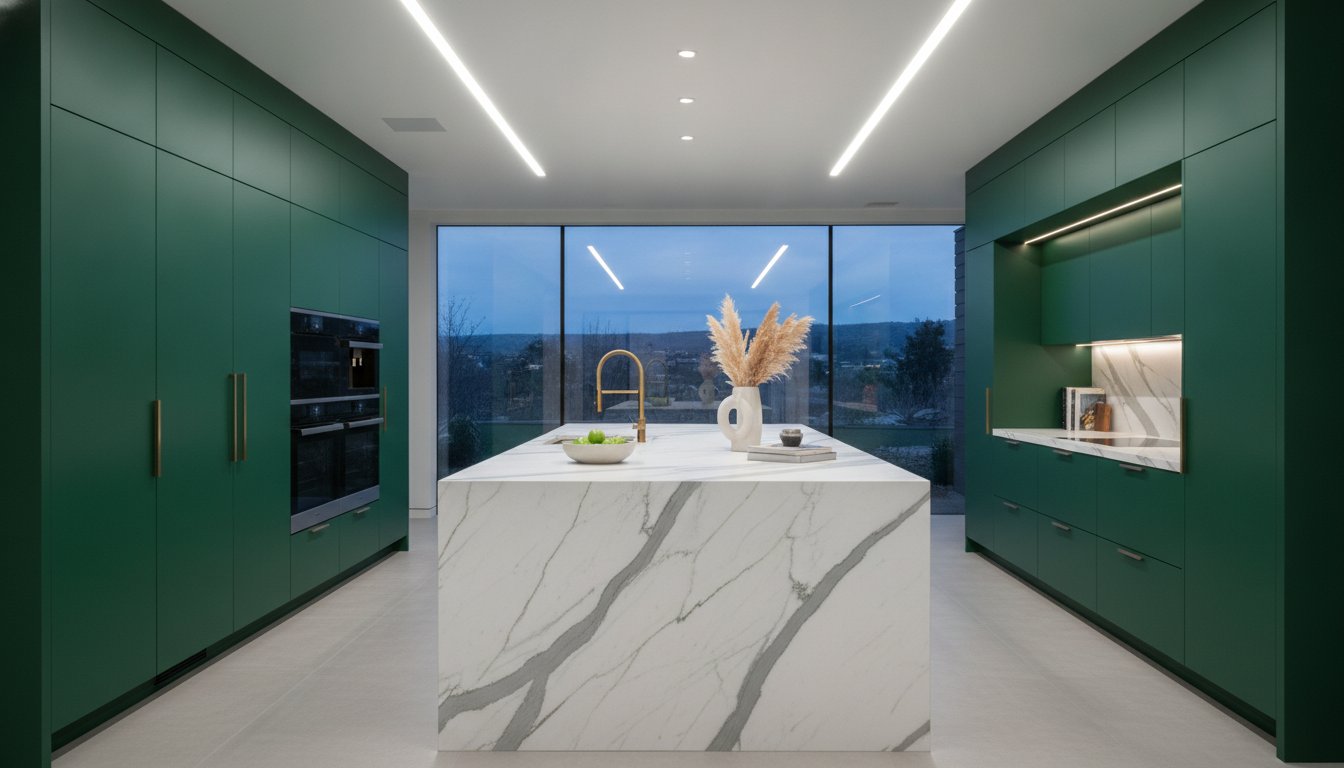
The 2026 aesthetic landscape demands a synthesis of bold visual statements and quiet technical excellence. Modern luxury kitchen cabinet design is moving away from safe, monochromatic neutrals in favor of the 'Jewel-Box Kitchen.' This style utilizes saturated colors like deep emerald, navy, and charcoal paired with high-contrast hardware in unlacquered brass or polished nickel. Achieving this look requires a multi-step finishing process that yields a perfectly smooth surface, free from the orange peel or brush marks common in mass-produced units. The cabinetry becomes a focal point that anchors the room's architectural identity.
Minimalism has also evolved into the 'City Slicker' style. This movement prioritizes handle-less cabinetry and integrated touch-latch technology for a completely flush appearance. It relies entirely on the precision alignment standards discussed in previous sections. Even a two-millimeter deviation in a handle-less drawer bank will disrupt the visual flow and mechanical function of the entire kitchen. Two-tone cabinetry also remains a staple for balancing visual weight; designers often utilize darker base units to ground the room while lighter uppers or open shelving maintain an airy atmosphere.
Natural wood grains, specifically Walnut and Rift Sawn Oak, are seeing a significant resurgence in luxury environments. These materials provide an organic counterpoint to high-performance stone surfaces. For the Denver climate, rift-sawn oak is particularly valuable because its vertical grain structure is more dimensionally stable than flat-sawn alternatives. This prevents the panels from expanding or contracting excessively in dry air, ensuring the doors remain square and the gaps stay consistent throughout the year.
The 2026 Color Palette: Sophisticated Greens and Earth Tones
The 2026 palette is dominated by sophisticated greens and earth tones. Sage, forest, and avocado hues are frequently integrated with natural stone accents to create a grounded feel. Lighting design plays a critical role here. Saturated colors absorb light differently than whites; without strategic LED placement, a deep forest green can appear muddy. The technical challenge lies in the high-pigment application, which must be cured in a controlled environment to ensure the depth of color remains consistent across all panels.
The Sculptural Kitchen: Unconventional Shapes and Islands
Modern luxury is moving beyond the standard rectangle toward the sculptural kitchen. This includes curved cabinetry and radius corners that soften the room's architectural lines. Engineering these units requires specialized jigs and meticulous veneer matching to ensure the grain remains continuous around the curve. These elements are often showcased in custom islands that function as both art and utility. For a deeper look at these complex structures, see Architectural Precision in Custom Kitchen Island Design (2026).
Strategic Selection: Materials, Hardware, and Integration
Successful luxury kitchen cabinet design requires a selection process that accounts for both mechanical tolerances and the specific environmental stressors of the region. While the visual impact of a wood species is immediate, its structural stability is the more critical factor for long-term performance. In high-stakes renovations, hardware and material choice serve as the technical bridge between the cabinetry and the architectural finishes of the home. Every component must be selected with the understanding that it'll be subjected to decades of mechanical use and environmental exposure.
Hardware acts as the 'jewelry' of the kitchen, providing a tactile point of contact that reinforces the quality of the build. Selecting unlacquered brass, matte black, or polished nickel requires an understanding of how these finishes will age and interact with the cabinetry's protective coatings. These selections must be coordinated with the stone installation to ensure that flush-mount sinks and cooktops align perfectly with the surrounding surfaces. This level of precision ensures the transition between wood, metal, and stone remains seamless.
Denver-Specific Material Considerations
Denver's high altitude and low humidity levels create a challenging environment for natural wood. Standard lumber often contains residual moisture that, when exposed to Colorado's arid air, leads to significant warping or splitting. Kiln-dried wood is an absolute requirement to ensure the moisture content is stabilized before assembly. For modern slab-style doors, engineered wood cores provide superior dimensional stability. These cores resist the natural tendency of wood to expand and contract, allowing for the tight, precise tolerances necessary in premium luxury kitchen cabinet design.
High-End Appliance Integration
Integrating professional-grade units like Wolf or JennAir requires surgical precision in the cabinetry's dimensions. Zero-clearance refrigerator installations leave no room for error; the cabinet box must be perfectly square to allow the appliance panels to sit flush with the surrounding doors. Ventilation engineering is equally vital. Custom cabinetry must be designed to manage the heat output of high-performance ranges without compromising the integrity of the wood or the finish. This level of coordination often requires upgrading plumbing and electrical systems to support the increased load of luxury appliances. Achieving this level of integration requires a partner who understands the technical nuances of high-end builds. You can consult with Brekhus Remodeling to ensure your cabinetry serves as a high-performance foundation for your kitchen.
Executing the Vision: The Brekhus Remodeling Standard
Execution represents the final, most critical phase of luxury kitchen cabinet design. It's the moment where engineering blueprints transform into a functional architectural masterpiece. Brekhus Remodeling operates with a disciplined, technical methodology that treats every kitchen transformation as a high-stakes construction project. We don't view cabinetry as a standalone feature. It's the core of a synchronized system involving structural supports, electrical routing, and plumbing integration. This "studs-out" approach ensures that the hidden infrastructure is as robust as the visible finishes.
Our specialized expertise in stone and tile installation is fundamental to this process. A heavy quartzite island or a full-height marble backsplash cannot be successfully installed on a weak or unlevel foundation. By managing the entire renovation in-house, we ensure that every utility line is positioned with surgical accuracy before the first cabinet box is set. This single-source approach eliminates the communication gaps that often plague complex renovations, providing a steady and reliable partnership for homeowners who demand professional rigor.
The Precision Installation Process
Laser-leveling is the only acceptable standard for high-end fitment. We don't rely on standard shimming to mask structural inconsistencies in the subfloor or walls. Instead, we utilize custom scribing to ensure cabinetry sits perfectly flush against stone or tile surfaces. This creates the seamless integration required for a modern aesthetic. The final phase involves the art of the perfect reveal. This requires microscopic adjustments to hinges and drawer glides to ensure that vertical and horizontal gaps are perfectly uniform across the entire kitchen. When these tolerances are met, the cabinetry functions with a silent, mechanical smoothness that defines true luxury.
Long-Term Value and Warranty of Craftsmanship
A kitchen built to these standards is a permanent structural asset rather than a temporary upgrade. We build for the next generation, ensuring that the mechanical components and finishes withstand decades of rigorous use. In the competitive Denver market, this level of technical integrity results in a measurable increase in home resale value. Buyers recognize the difference between a cosmetic refresh and a professionally engineered renovation. It's a legacy of quality that remains stable and functional long after the project's completion. Consult with Brekhus Remodeling for your custom kitchen vision to begin the process of engineering your permanent architectural legacy.
Securing the Future of Your Kitchen Transformation
A successful renovation transcends superficial beauty by prioritizing the mechanical integrity of the build. We've established that high-performance luxury kitchen cabinet design is a permanent structural investment. It requires a rigorous synergy between material science and architectural precision. From the stability of kiln-dried wood in Denver's arid climate to the surgical integration of professional appliances, every technical decision must prioritize longevity over temporary trends.
Since 2004, Brekhus Remodeling has provided the professional rigor necessary for these complex, high-stakes projects. Our mastery of stone and tile installation ensures your cabinetry serves as a rigid, reliable foundation for heavy surfaces. We manage the full technical scope, including critical plumbing and electrical coordination, to guarantee a high-performance workspace that functions flawlessly for decades. Your vision for a durable architectural masterpiece is achievable through disciplined planning and execution.
Schedule a technical consultation for your Denver luxury kitchen remodel. We look forward to engineering a kitchen that serves as a permanent asset to your home.
Frequently Asked Questions
What is the difference between custom and semi-custom kitchen cabinets?
Custom cabinets are engineered to specific architectural dimensions without the constraints of modular box sizes. Semi-custom cabinets rely on fixed-size units, often requiring fillers to bridge gaps between the cabinet and the wall. True custom design utilizes every millimeter of available space, ensuring a seamless fit and superior storage efficiency in complex layouts.
How does Denver's dry climate affect luxury wood cabinets?
Low humidity levels in Colorado cause standard wood to shrink, warp, or crack if the material isn't properly stabilized. Luxury cabinetry must utilize kiln-dried lumber and engineered wood cores to maintain dimensional integrity. These technical standards prevent door misalignment and structural failure, ensuring the units remain square despite the arid atmospheric conditions.
What are the most durable materials for high-end kitchen cabinet design?
The benchmark for durability is 3/4-inch Grade A plywood for cabinet boxes and solid wood for frames and doors. These materials provide the necessary screw-holding power and rigidity to support heavy stone countertops. Protective layers should consist of multi-step catalyzed conversion varnishes, which create a moisture-resistant barrier superior to standard paint finishes.
Can high-end appliances like Wolf or Sub-Zero be fully camouflaged by cabinetry?
Professional-grade appliances can be fully integrated into the design using custom-milled panels that match the surrounding cabinetry. This requires zero-clearance engineering and precise coordination of plumbing and electrical systems. When executed correctly, the appliance sits flush with the cabinet doors, creating a unified architectural surface across the entire kitchen.
How long does a custom kitchen cabinet installation typically take?
The installation phase for a high-end project generally requires several weeks of on-site technical work. This timeline accounts for laser-leveling, custom scribing against stone or tile, and the fine-tuning of mechanical reveals. Each unit must be meticulously adjusted to ensure the final fitment meets the rigorous standards of a permanent structural asset.
Why is dovetail joinery considered the standard for luxury cabinetry?
Dovetail joinery provides a superior mechanical bond through interlocking wedge-shaped tails and pins. This design resists being pulled apart, ensuring that drawers can support significant weight loads without structural failure. It remains a hallmark of luxury kitchen cabinet design because it guarantees the longevity of the drawer box under daily mechanical stress.
What cabinet colors are trending for luxury kitchens in 2026?
The 2026 landscape is dominated by saturated earth tones, specifically forest green, sage, and deep navy. These hues are frequently paired with natural wood grains like Walnut and Rift Sawn Oak to create a grounded, sophisticated atmosphere. Achieving these looks in luxury kitchen cabinet design requires high-pigment finishes that maintain color depth under strategic lighting.
Is it possible to install floor-to-ceiling cabinets in an older Denver home?
Floor-to-ceiling integration is achievable in older properties through meticulous structural assessment and custom scribing. Older homes often feature uneven ceilings and floors that require cabinetry to be adjusted on-site for a perfectly level fit. This approach maximizes storage while correcting visual architectural inconsistencies, resulting in a clean, modern aesthetic.