Selecting Kitchen and Counters: A Masterclass in High-End Material Engineering
Master the engineering behind high-end kitchen and counters. Our guide covers material selection, from quartz to quartzite, to prevent cracks and ensure perf...
A premium kitchen island is not a piece of furniture; it's a high-performance structural assembly that must withstand decades of thermal shock and mechanical stress. Selecting the ideal materials for kitchen and counters involves far more than aesthetic preference. It requires a deep understanding of mineral composition and load-bearing capacity. Many homeowners find themselves paralyzed by the technical nuances of stone selection, fearing that a single oversight in material choice or installation could lead to visible cracks or permanent staining.
We understand that a high-end renovation demands perfection in every detail. This masterclass serves as an authoritative resource for those seeking to integrate premium surfaces with the technical rigor of a master builder. You'll learn the critical distinctions between engineered quartz and natural quartzite, the standards for seamless plumbing integration, and the installation protocols that protect your home's value. This guide provides the clarity needed to move beyond the showroom and into the realm of professional engineering, ensuring your kitchen functions as a durable, high-performance workspace.
Key Takeaways
- Understand the critical relationship between countertop weight and cabinetry reinforcement to ensure long-term structural integrity.
- Master the technical differences between natural quartzite and engineered quartz to select the ideal material for high-performance kitchen and counters.
- Learn how to coordinate complex plumbing and electrical systems with precision stone cutouts for a seamless mechanical finish.
- Identify the rigorous framework for inspecting stone slabs for mineral inclusions and executing sophisticated vein-matching techniques.
- Discover the professional standards for achieving invisible seams and ensuring a perfectly level substrate for heavy stone surfaces.
The Architectural Role of Kitchen and Counters in Custom Remodeling
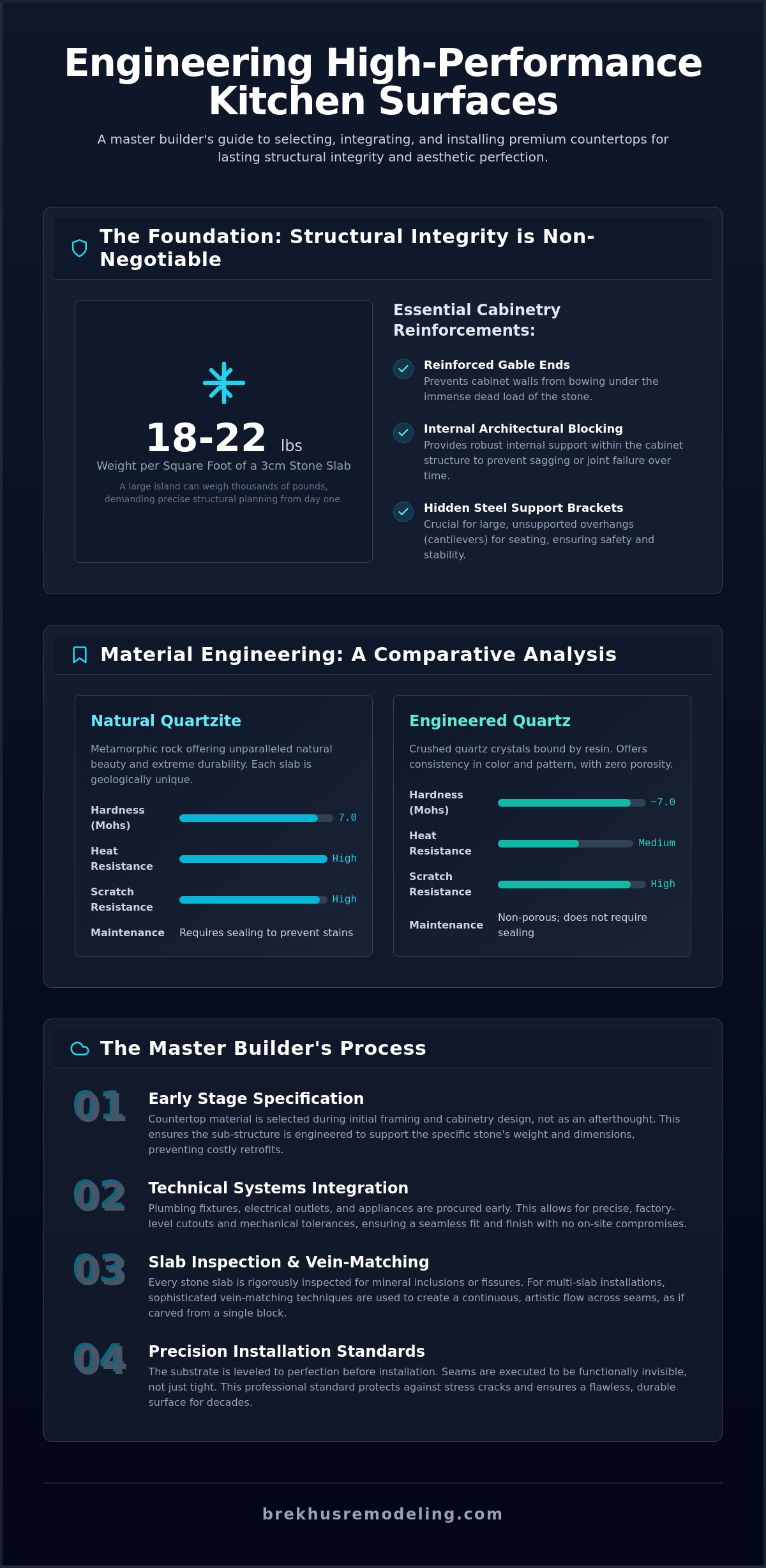
In high-end residential architecture, the kitchen counter functions as the primary high-performance surface. It isn't just a decorative plane; it's a technical component that dictates the structural requirements of the entire room. During the design of kitchen and counters, the selection of the slab must occur during the initial framing and cabinetry design phases. This early-stage specification ensures that the sub-structure can support the immense dead loads associated with premium stone. Failure to account for these variables early in the remodeling process often leads to costly structural retrofits or compromised aesthetics.
A standard 3cm granite or quartzite slab weighs approximately 18 to 22 pounds per square foot. For a large-scale island, this translates to thousands of pounds resting on a finished floor and cabinetry. Professional remodeling requires reinforced gable ends and internal architectural blocking to prevent sagging or joint failure. The relationship between material weight and cabinetry reinforcement is absolute. We don't view stone as a simple overlay. We view it as a load-bearing element that requires precise planning to maintain structural integrity over decades of use.
Material selection also dictates the project's critical path. Lead times for custom stone fabrication in Denver can extend several weeks, depending on the complexity of the edge profiles and the rarity of the slab. Specifying these materials at the start of the project allows for the early procurement of plumbing fixtures and appliances. This synchronization ensures that sink cutouts and mechanical tolerances are perfectly aligned. It prevents the common anxiety of poor installation seams or mismatched plumbing connections that often plague less disciplined builds.
Balancing Aesthetic Intent with Structural Requirements
The choice between 2cm and 3cm stone directly impacts cabinet height and edge profile options. While 2cm stone may offer a sleeker profile, it often requires a plywood sub-top for strength, which changes the finished height of the workspace. Large cantilevers for seating areas require hidden steel support brackets integrated into the cabinet carcasses before the stone arrives. This level of coordination ensures that the architectural vision remains safe and durable. We prioritize these structural details to ensure the stone remains stable and crack-free for the life of the home.
The Long-Term Value of Premium Surfaces
Investment in natural stone offers a superior return compared to synthetic alternatives. High-performance countertop materials like quartzite or premium granite provide a level of heat and scratch resistance that engineered resins cannot match. In the Denver market, discerning buyers prioritize longevity and structural permanence over flashy, temporary trends. Choosing a material based on technical merit and geological stability protects the property's value. It's a commitment to a standard of excellence that transcends simple aesthetics and focuses on lasting performance.
Material Engineering: Comparing High-Performance Kitchen Surfaces
High-performance kitchen and counters are defined by their resistance to mechanical and chemical degradation. While aesthetic appeal is a given in luxury remodeling, technical metrics like mineral hardness and thermal stability dictate the surface's long-term utility. We evaluate every slab based on its geological origin and engineered properties to ensure it meets the rigorous demands of a professional-grade workspace. Understanding the Mohs Scale of Hardness is the first step in this process; a material like quartzite, which ranks at a 7, offers significantly higher scratch resistance than marble, which typically ranks between 3 and 4.
Porosity and absorption rates are equally critical for maintaining a sterile, stain-resistant environment. Natural stone contains microscopic voids that can harbor liquids if not managed correctly. Engineering a stain-resistant workspace requires selecting materials with low absorption rates or ensuring a high-quality impregnating sealer is applied. For those who prioritize a low-maintenance lifestyle, understanding these maintenance cycles is vital before the stone is even cut.
Natural Stone: Quartzite, Granite, and Marble
Natural quartzite represents the pinnacle of metamorphic stone engineering. It offers the crystalline beauty of marble but with a density that makes it virtually impervious to scratches from stainless steel cutlery. Granite remains a staple for high-performance zones due to its ruggedness and heat resistance, though it requires periodic sealing to maintain its integrity. For specialized baking areas, marble is often specified for its high thermal mass, which keeps pastry dough cool. However, its sensitivity to acidic substances requires strategic placement rather than full-surface application in high-traffic zones.
Engineered Solutions: Quartz and Porcelain Slabs
Engineered quartz consists of approximately 90% to 93% crushed mineral bound by polymer resins. While this composition creates a non-porous surface, it introduces a critical performance limit: a relatively low Heat Deflection Temperature (HDT). Direct contact with high-temperature cookware can cause permanent resin scorching or discoloration. Porcelain slabs offer a different engineering profile. These large-format surfaces are manufactured through extreme heat and pressure, resulting in a mineral-only composition that handles thermal shock far better than resin-based quartz. Ensuring your selection aligns with your cooking habits requires a stone installation partner who understands these technical nuances.
- Quartzite: High hardness (Mohs 7), heat resistant, requires sealing.
- Quartz: Non-porous, resin-bound, sensitive to high heat.
- Porcelain: Ultra-thin profiles, zero porosity, high thermal stability.
- Granite: High durability, varied mineralogy, industry-standard performance.
Technical Integration: Plumbing, Electrical, and Mechanical Coordination
The successful execution of high-end kitchen and counters depends entirely on the precision of mechanical integration. A slab of quartzite is a static object until it's machined to accept plumbing fixtures, electrical interfaces, and professional-grade appliances. This phase of the remodel demands a level of accuracy where tolerances are measured in fractions of a millimeter. We don't simply cut stone; we engineer a functional interface between the home's infrastructure and its most visible surfaces.
Precision sink cutouts represent a significant engineering challenge. Under-mount sinks require a polished internal edge that must remain perfectly concentric with the basin. Flush-mount installations are even more demanding. They necessitate a recessed ledge within the stone so the sink rim sits exactly level with the counter surface. For apron-front or "farmhouse" sinks, the structural coordination begins with the cabinetry. The weight of a water-filled cast iron sink, combined with the surrounding stone, requires a reinforced support cradle. This prevents settling or separation over time.
Modern luxury kitchens often feature integrated electrical pop-ups or stone-matched outlet covers to preserve the visual continuity of a full-height backsplash. Installing these components requires early-stage coordination with electrical teams. For homes in Denver, complying with the 2025 Denver Building Codes means ensuring all electrical modifications meet the latest safety standards for kitchen circuits. Upgrading plumbing and electrical systems is a prerequisite for any remodel involving heavy stone. Accessing these systems after the slabs are set is difficult and risks damage to the material.
Water Management and Sealant Integrity
Water management is the silent protector of structural integrity. We apply professional-grade waterproofing at every sink and faucet penetration to prevent moisture from reaching the cabinetry below. Sealant selection isn't a generic choice. It's based on the specific mineralogy of the stone and its expected chemical exposure. Our expertise in custom shower installs informs this process. We apply the same rigorous standards for moisture barriers and joint precision to the kitchen backsplash.
Electrical and Appliance Clearances
Managing mechanical tolerances for high-end appliances involves more than just measuring the width of a range. Professional-grade cooktops often require integrated downdraft venting or specific rear clearances that must be cut into the stone with absolute certainty. We coordinate with appliance manufacturers to ensure flush transitions between stone counters and custom cabinetry. Every millimeter of clearance is planned to prevent vibration damage. This ensures the finished assembly feels like a single, cohesive piece of high-performance architecture.

The Selection Framework: Sourcing and Edge Profile Specification
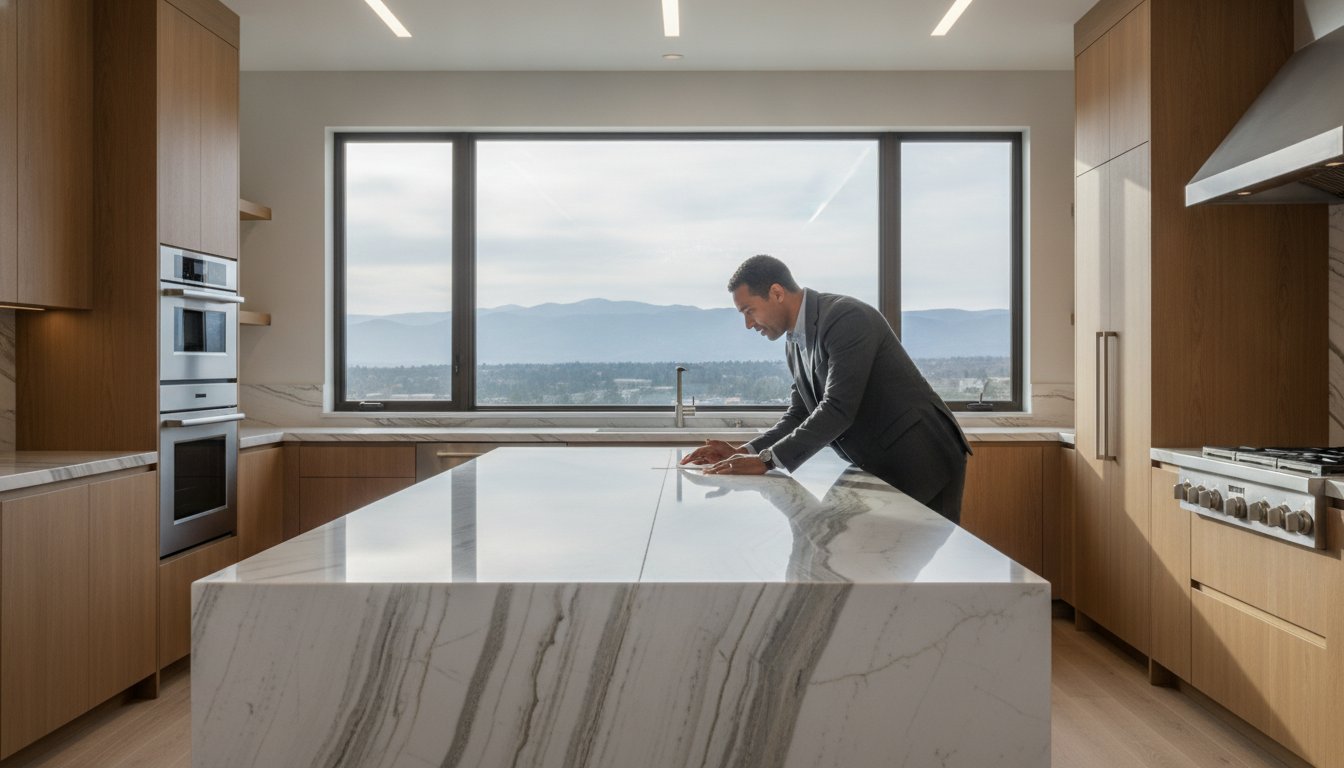
Selecting the raw material for kitchen and counters requires a disciplined eye for geological detail. We don't rely on digital catalogs or small samples. Every slab must be physically inspected for structural fissures and mineral inclusions that could lead to failure during fabrication or installation. A fissure is more than a visual blemish; it's a structural discontinuity that can expand under the mechanical stress of a home remodel. Meticulous inspection ensures that the stone we select is as durable as it is beautiful. It isn't just about color. It's about mineral stability.
Engineering the visual flow of a kitchen requires advanced vein-matching techniques. For large-scale projects, we utilize book-matching, where adjacent slabs from the same quarry block are polished on opposite sides. This creates a mirrored effect that transforms a simple surface into an architectural centerpiece. This level of precision is only possible through digital templating. We use laser-guided systems to map the exact contours of the site. This data is then used to program CNC machines for fabrication, ensuring that every cutout for sinks, cooktops, and pop-up outlets is positioned with absolute certainty. This architectural precision is the bridge between a raw slab and a finished, high-performance workspace.
Navigating Stone Sourcing in Denver
Local slab yards offer a critical advantage for material verification. Denver’s arid, high-altitude climate can affect the moisture content and stability of natural stone. Acclimation is essential. Working with an established custom kitchen remodeling specialist ensures you gain access to premium lots that have been properly handled and stored. These professional relationships allow us to secure the highest grade of stone before it reaches the general market, protecting the integrity of your investment from the start.
Edge Profiles and Aesthetic Detailing
Architectural detailing defines the final character of the stone. While an eased edge offers a clean, minimalist look, architectural mitered aprons provide a sense of massive, solid-block construction. A mitered edge involves joining two 45-degree cuts to create a seamless vertical drop. This technique is essential for waterfall transitions, where the stone flows from the horizontal counter to the floor. It creates a monolithic appearance that is a hallmark of high-end design.
Specific edge profiles also impact the durability of your kitchen and counters. Sharp, 90-degree corners are more prone to chipping in high-traffic areas. We often recommend a slight radius or a "pencil" edge to mitigate this risk without compromising the modern aesthetic. Beyond aesthetics, edge profiles play a functional role in spill containment. A properly specified drip groove on the underside of the stone can prevent liquids from reaching the cabinetry. Every detail, from the mitered joint to the eased corner, is a deliberate engineering choice made to ensure long-term performance.
Executing the Vision: Professional Installation Standards in Denver
The final phase of a high-end residential remodel is where technical theory meets physical reality. Executing the vision for kitchen and counters requires a zero-tolerance approach to installation, as even the most premium slab can fail if the foundation is compromised. At this stage, our focus shifts from material selection to the rigorous assembly of the workspace. We ensure that every component, from the reinforced cabinetry to the mechanical interfaces, is prepared to accept the immense weight of the stone. Professional installation isn't just about placement; it's about the permanent stabilization of a structural asset.
Substrate preparation is the first and most critical step in ensuring architectural longevity. We verify that the cabinetry and sub-flooring are perfectly level across the entire span of the installation. For large-scale kitchen islands, this often involves fine-tuning the base structures to account for the dead load of the stone, which we previously identified as exceeding 20 pounds per square foot. We don't rely on shims as a primary solution. Instead, we ensure the structural foundation is engineered to be plumb and level from the outset. This precision prevents the internal stresses that lead to stone fracturing over time.
Precision Seam Placement and Leveling
Achieving the "Brekhus Standard" means creating transitions that are nearly imperceptible to the eye and touch. We utilize mechanical seam setters and color-matched epoxy resins to achieve zero-tolerance joints. Strategic seam placement is dictated by the stone's vein pattern and the structural requirements of the layout. We avoid placing seams near sink cutouts or high-stress cantilevers whenever possible. Once the stone is set, professional finishing ensures that the transition between the counter and the backsplash is seamless. This level of detail often requires final coordination with our painting and finishing teams to ensure the surrounding architectural elements match the caliber of the stone.
The Brekhus Remodeling Commitment to Excellence
Our history in Denver dates back to 2004, providing us with a deep understanding of the local geological and climatic factors that influence stone performance. This legacy informs our rigorous installation protocols. We provide end-to-end management, coordinating the complex interplay between stone installation, plumbing, and electrical systems. This holistic approach eliminates the communication gaps that occur when multiple subcontractors are involved. It ensures that your kitchen and counters function as a high-performance workspace from the moment the project is completed.
Maintaining the integrity of premium surfaces requires a dedicated maintenance protocol. Post-installation, we establish a specific care schedule based on your material's mineralogy. This includes specifying pH-neutral cleaners and identifying the appropriate intervals for re-sealing natural stone. If you're ready to move forward with a master craftsman who prioritizes technical integrity, the next step is a formal consultation to review your architectural plans and material specifications.
Advancing Toward Architectural Excellence
Integrating high-performance kitchen and counters into a residential remodel requires a shift from viewing surfaces as decor to viewing them as engineered components. We've examined the critical necessity of structural reinforcement, the technical differences in mineral hardness, and the precision required for mechanical coordination. These elements combined ensure that a premium renovation remains a durable, high-performance workspace for decades. Success in high-end remodeling is found in the details of substrate preparation and the accuracy of stone-matched mechanical interfaces.
Brekhus Remodeling brings over 20 years of expertise to Denver residential remodeling, providing specialized mastery in stone and tile installation. Our process includes full-service technical support for plumbing and electrical systems, ensuring that every slab is integrated with absolute accuracy. We manage the high-stakes complexity of custom builds to protect the long-term value of your property. Consult with Brekhus Remodeling for your custom kitchen and counters to secure the structural integrity and aesthetic permanence your home deserves. We look forward to engineering a space that exceeds your highest standards.
Frequently Asked Questions
What is the most durable stone for a high-use kitchen in 2026?
Natural quartzite remains the pinnacle of durability for high-performance environments due to its superior hardness and resistance to thermal shock. While granite is a traditional standard, quartzite offers a denser mineral structure that better resists scratching from stainless steel cutlery. For those seeking zero porosity, porcelain slabs provide an engineered alternative that handles extreme heat and chemical exposure without the risk of resin scorching.
How do I choose between 2cm and 3cm stone thickness for my counters?
3cm stone is the preferred specification for high-end residential remodeling because it provides superior structural integrity and a more substantial architectural presence. 2cm stone is typically reserved for vertical applications like backsplashes or when a minimalist, thin-profile aesthetic is desired. Horizontal 2cm installations often require a plywood sub-top to prevent fracturing, which can complicate the finished height of the cabinetry and appliance integration.
Can I install new counters on my existing kitchen cabinets?
Installation on existing cabinetry is possible only if the structures are perfectly level and capable of supporting the immense dead load of premium stone. We perform a rigorous structural assessment to identify any signs of settling or joint failure before the stone is set. If the existing cabinets lack reinforced gable ends or internal architectural blocking, structural retrofitting must occur to ensure the long-term stability of the new surfaces.
What is the difference between quartz and quartzite for kitchen counters?
Quartzite is a natural metamorphic stone with high heat resistance and unique geological veining. Engineered quartz is a manufactured product consisting of mineral dust bound by polymer resins. While quartz is non-porous, it has a lower heat deflection temperature, meaning direct contact with hot cookware can cause permanent resin damage. Quartzite offers the durability of natural stone but requires periodic sealing to maintain its stain resistance.
How are seams managed in large-scale natural stone installations?
We achieve zero-tolerance transitions through the use of mechanical seam setters and color-matched epoxy resins that mimic the stone's base hue. Strategic seam placement is determined during the digital templating phase to ensure the joint is located in a low-stress area and aligned with the mineral's natural vein flow. This methodical approach ensures that the finished assembly maintains the visual continuity of a single, monolithic block.
Do I need to seal my kitchen counters, and how often?
Natural stone surfaces require periodic sealing with high-performance impregnating sealers to prevent moisture and oil absorption. The re-application interval depends on the specific mineralogy and porosity of the slab, though most premium quartzite and granite installations require sealing every one to three years. Engineered surfaces like quartz and porcelain are non-porous and do not require chemical sealants to maintain their integrity.
How does a kitchen island design impact the choice of counter material?
The scale and geometry of a kitchen island dictate the slab dimensions required to minimize seams and execute complex details like waterfall edges. When selecting materials for kitchen and counters, large islands often require book-matched slabs to ensure the vein pattern flows seamlessly from the horizontal surface to the floor. The island design also determines the placement of hidden steel support brackets necessary for seating cantilevers.
What is the typical timeframe for stone fabrication and installation in Denver?
The typical timeframe for custom stone fabrication in Denver ranges from two to four weeks following the completion of the physical template. This schedule allows for the precision CNC machining of edge profiles and the hand-finishing required for high-end mitered joints. We synchronize this timeline with plumbing and electrical teams to ensure that all mechanical integrations are completed immediately after the stone is set.